The Blaster In Question #0029: Barrel Break IX-2

BARREL BREAK IX-2

N-STRIKE

After last week’s rather downer review, I need something to pick me back up.  Bonus points if it restores my faith in the regular N-Strike series.  What’s this?  Oh, praise the gods, it’s the Barrel Break.  Faith is restored, and by a shotgun no less.  So what is this masterpiece of toy craftsmanship?  Does it really make up for the SharpFire?  Am I maybe over-hyping it a little?  All these questions will be answered in due time.

THE BLASTER ITSELF

Ok, it’s probably due time now, so let me address your questions in no particular order; maybe a little, not really since the SharpFire came out afterward and it’s hard to make up for something that comes later, and this is the Barrel Break IX-2.  That answer everything?  Good, moving on.  The Barrel Break IX-2 was released in 2010 as part of the N-Strike line.  Its main draw was the unique and fairly unorthodox method of loading the blaster.  By pressing the lever on either side of the blaster, you unlock the barrels which slide forward and then pivot downward like a break action shotgun.  You then load the darts into the barrels, pivot them back into alignment and push them back into the body of the blaster.  You then are able to fire either one dart at a time or both at once thanks to the 2 separate air chambers, much like the Roughcut that would come later.  Where the Roughcut would use gears to assist priming both springs at once, the Barrel Break simply uses the mechanical advantage of the barrels acting as a long lever when pushed down to prime the plungers.  The whole system may be a little complex, but back in my days of collegiate Humans Vs Zombies, this blaster was an easy choice for backup.  The ability to fire two shots in rapid succession was a big help during the day, and its tolerance for all ammo types gave a decent advantage during missions when scrounging darts off the ground was commonplace.  It should be noted that while clip system blasters obviously couldn’t use broad heads, there were more than a handful of non-clip blasters that wouldn’t reliably fire streamlines either.  The Barrel Break uses all new sculpting and mechanics and has one attachment rail along the top of the blaster.  It does show a few signs of its time such as the plastic being a little creakier than more recent blasters, but even so, the fun of the whole thing is hard to deny.  Creaking aside, in hand the blaster feels pretty good.  My only gripe in this area is that the front of the grip is a little narrow and can put just a little more pressure on my fingers than I’d like when holding it for a long time.  The grip is severely angled which helps confirm that this is meant to be a trusty double-barrel more than anything.  The angle does make aiming down sights a little awkward, but let’s be honest, this isn’t a blaster to be aimed.  The performance is another way the Barrel Break shows its age.  While it had pretty great out-of-the-box range and power when it was released, the standard has been moved up since then.  It’ll still work fine as an indoor/sibling attack blaster, but I still think most of the enjoyment I get out of it is the satisfying mechanical feeling of reloading and that hasn’t changed a bit.  The Barrel Break IX-2 comes packaged with 10 whistler darts and a clip-on dart holder that attaches to the rail.  I still have it, at least, I still have all of its parts, but I may have taken it apart slightly so I could put it on a sleeve instead.

THE ME HALF OF THE EQUATION

That felt better.  I know a lot of people will say that there are plenty of better choices out there for an HvZ blaster than the Barrel Break, and I might agree with them on some points but I stand by my choice.  Even outside HvZ, I recognize that it’s a lot of steps to fire 2 darts, but you’ll definitely have fun doing it.  In that sense, I don’t know that I can think of a better example of pure fun outweighing functionality in a Nerf blaster without getting into the Max Force line.
 

The Blaster In Question #0028: SharpFire

SHARPFIRE

N-STRIKE

This week, we’ll be playing the NES classic, Duckhunt using the zapper light gun.  Wait, hang on.  Nope, scratch that, this is a Nerf blaster, but let’s be fair, you can understand my confusion.  I mean, look at it.  Ok, fine, we can look at it together.  Let’s get into reviewing the N-Strike SharpFire.

THE BLASTER ITSELF

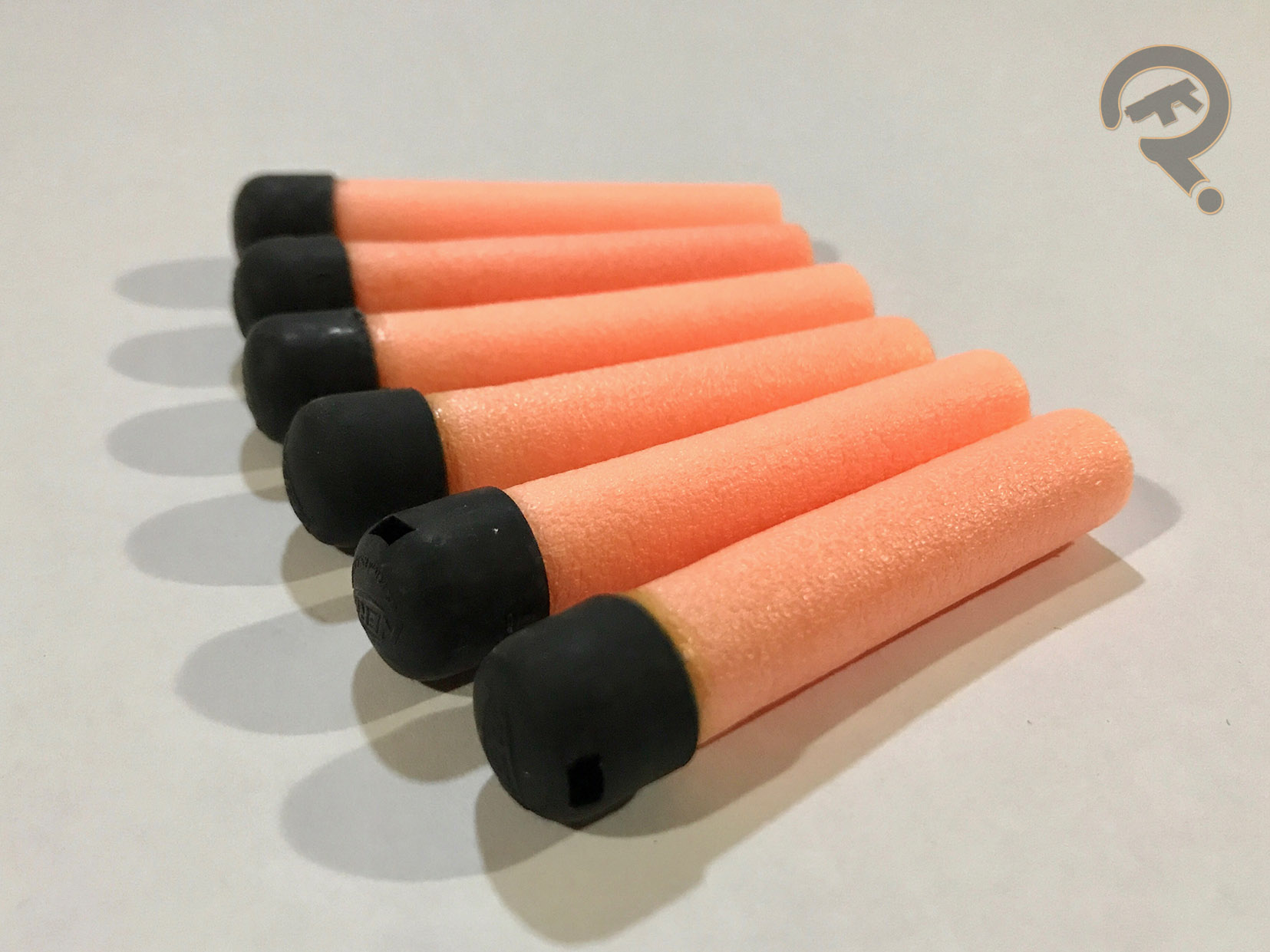
The SharpFire was released in 2015 as part of the N-Strike series which was a little odd seeing as N-Strike Elite had already been launched several years prior.  It is a single-shot, breach-loading pistol/rifle thing.  It’s a bit of a mess, quite frankly.  To my knowledge, it was the first Nerf blaster to use this breach-loading mechanism but not the last as it has also appeared in the Modulus and Accustrike lines as the IonFire and FalconFire respectively.  The core blaster can be used on its own as a small pistol or combined with the included (and proprietary) stock and barrel extension.  The barrel extension is just a tube that snaps on the front, but the stock can be reversed and used as a holster of sorts.  It even has a belt clip on one side and can hold 6 extra darts in storage as well as holding onto the barrel extension when not in use.  The shell of the blaster is completely original and has only seen reuse in the SharpFire Delta, effectively just a recolor and without the accessories.  The ergonomics of the SharpFire leave something to be desired.  The lump on the back of the pistol grip makes achieving a firm grip rather awkward, and the barrel and stock are too short.  The stock is especially uncomfortable as it has no semblance of a cheek rest of any kind, leaving your head floating awkwardly behind the blaster as you hunch way down to get any kind of sight picture.  The whole thing is quite literally a pain in the neck.  This is not helped by the fact that the barrel attachment mechanism is so poorly designed that it is both too tight where it causes stress marks in the plastic from attaching and detaching, but also too loose so the barrel never stays on straight.  As a pistol, my left hand can wrap around the fingers of my right hand in a standard grip, but as a rifle (kinda sorta), It feels like there should be something more substantial to hold on to in the front of the blaster and there isn’t.  These would be bad enough except that both of these accessories are only compatible with the SharpFire, and likewise, the SharpFire can’t accept standard attachments.  Performance isn’t exactly stellar either.  With just the core blaster, many shots seem to idly coast through the air before dropping to the floor as opposed to the speed and force seen with Elite series blasters, which again, had been out for 3 years at this point.  I just feel like I need to point that out again.  With the barrel attachment on, the loose fit would sometimes mean that darts would impact the inside of the barrel and slow down before exiting the blaster, leading to some hilariously flaccid shots.  Needless to say, you don’t want this happening when you decide to bust into your younger sibling’s room.  You’ve got an image to maintain.  The SharpFire comes packaged with its stock, barrel extension, and 10 N-Strike Elite darts.

THE ME HALF OF THE EQUATION

Hoo-boy.  That was a rough one.  When it was first shown in a leaked promo image back in 2014, I was super excited for it to come out because it didn’t look like anything that had come out before it.  I was really confused why no one else seemed interested in what could have potentially been a dedicated Nerf sniper.  Then it came out and I figured out why.  I guess it’s hard to convey scale on a low res leaked picture but this thing really is just kind of disappointing all around.


The Blaster In Question #0027: Zeus MXV-1200

ZEUS MXV-1200

RIVAL

You know what this page needs?  It needs more balls.  Like, just a little pile over there, like 2 cubic tons.  Ok, maybe not that many, more like just a few ounces.  And obviously, I’m talking about the Nerf Rival High-Impact Rounds.  What else could it be, you weirdo.  Yes, it’s another Rival review, and this time we’re looking at part 2 of the line’s debut release, named for the king of the gods himself, the Zeus MXV-1200.  Let’s check it out.

THE BLASTER ITSELF

Here’s a fun fact, the names of the Rival blasters are actually quite informative.  Let me break it down for you.  So far they all are named for a deity from the ancient Greek pantheon and that’s just to sound cool.  After that, if the first letter is an M, that stands for “motorized.”  If there’s no M, you can assume it’s spring powered.  The next letters are the Roman numerals for the last 2 digits of the blaster’s release year.  XV is 15, hence, the Zeus and Apollo came out in 2015.  Lastly, the number after the hyphen is the blaster’s initial magazine capacity multiplied by 100.  All clear?  Good, let’s move on.  As the name suggests, the Zeus is a semi-automatic flywheel powered blaster with a 12 round capacity using the included magazine.  The flywheel mechanism itself is nothing new, though it has been substantially beefed up to deliver the expected Rival performance.  The shell of the Zeus is completely original and features a unique in-line side loaded orientation for the magazine, using the magazine spring itself to feed rounds into the flywheels rather than some other pusher mechanism.  Exchanging magazines is a little tricky at first because of how unconventional the layout is, but with a little time you get used to it.  Something worth noting is that the Rival 12 round magazines are the only ones that will work with the Zeus.  The Zeus’s handling is pretty good, though I do have some minor gripes.  The blaster feels solid and rather hefty in the hand, but the housing for the motors sticks out kind of abruptly from the left side and can dig into your palm if you’re not holding it just right.  Also, the pistol grip feels a little slim and I might have preferred just a bit more there to hold onto.  There is a lever safety above the trigger that prevents the rev switch from being pressed when it’s engaged, but it’s got a lot of play before it actually clicks into place and feels like it was probably a last minute addition.  The Zeus sports 3 Rival attachment rails (not the standard Nerf rail, these are specific to Rival), one on each side and a longer one along the top of the blaster.  It also has flip-up sights to help with aiming but they sit a little low compared to the back end of the blaster so you have to really mash your face into the cheek rest to get a decent sight picture.  Functionally, the only complaint I have is that I wish inserting a magazine didn’t automatically make it push a round into the blaster.  Again, these are minor issues that I have and don’t affect my overall opinion of the blaster that much.  That’s because actually shooting the Zeus is a joy.  Unlike other flywheel dart blasters, the Zeus revs up with a sound I’ve often described as a bag of angry hornets, and that sound is very much understandable once you pull the trigger a few times.  It launches rounds on more or less a straight line trajectory for a good 50 feet before they exhibit any noticeable drop.  Rounds also hit hard, making indoor shooting kind of a bad idea if you don’t want to risk breaking anything.  The plus side of this is that usually, you don’t even need to shoot anything to freak out your sibling when you bust into their room.  Just rev the darn thing like a mother-something chainsaw (what?) and that’ll get your point across. The Zeus MXV-1200 requires 6 C batteries and comes packaged with 12 High-Impact Rounds and a 12 round magazine.

THE ME HALF OF THE EQUATION

The Zeus isn’t perfect.  Almost no blasters out there are, but it’s easily in the top 10% and very much a force to be reckoned with.  It sounds like thunder when it revs up, buzzy, high pitched thunder.  It hits like lightning.  There might be some hyperbole in there but you get the point.  It seems “Zeus” is an appropriate name for this blaster.  It’s not much of a womanizer though, so I guess that’s probably a point in it’s favor.

The Blaster In Question #0026: Bigshock & Hotshock

BIGSHOCK & HOTSHOCK

N-STRIKE ELITE (MEGA)

It’s another double review. Yes, Nerf has a bit of a tendency to iterate similar concepts again and again, particularly with smaller blasters. Today’s blasters are no exception to the rule and I felt I could get away with reviewing them both at once given their similarities. This week, I’ll be looking at the Mega series Bigshock and Hotshock (gotta love Nerf naming convention) blasters. So what’s the deal with these things? Let’s have a look-see.

THE BLASTERS THEMSELVES

So why would you be carrying around one of these goofy things? Calling yourself “The Shocker! I’m the Shocker! I shock people!” Well, that would be a weird thing to do, and you’d be weird for doing it. I mean, if you really want to, then more power to you I guess. But enough movie references. These blasters were released a little over a year apart with the Bigshock coming out in early 2015 and the Hotshock releasing in the later part of 2016. Both blasters function much the same way with the Bigshock simply a Mega upscale of the N-Strike Jolt, and the Hotshock being an inline configuration of the same mechanism. They are both front-loading single shot blasters that have storage for an additional Mega dart along the top of the blaster body. They perform as well as you’d expect a compact Mega blaster to do, shooting far and hard relative to their size. Both blasters come packaged with two Mega darts.

BIGSHOCK

When you really get down to it, the only real differences between the two are aesthetic and ergonomic. The Bigshock is the shorter, stubbier of the two and is laid out the same as a traditional Jolt with the air cylinder and plunger mechanism in the grip. In hand everything feels solid and reasonably hefty considering the size of the blaster. The structural ridges along the front of the grip can get uncomfortable to hold, digging into the pads of your fingers if you grip a little too tightly. On the Bigshock, if the dart storage on the top of the blaster is empty, there is a small peep hole in front that could maybe be used as some kind of sight if you really wanted, but it’s not great.

HOTSHOCK

The Hotshock goes for more of a traditional pistol look with a longer more streamlined body. Instead of the cylinder and plunger angling down to form the grip, they simply continue straight back, parallel to the barrel with a more conventional pistol grip below. Some places where the Hotshock beats out the Hotshock are primarily in handling. The plunger catch and trigger have a noticeably more tactile click than on the Bigshock and the grip is free from hard edges or sharp corners. Unfortunately that’s really all the Hotshock has in its favor. The grip, while much smoother, is also significantly shorter and my pinky hangs off the bottom. Additionally, the multiple layers of plastic have an unsettling amount of flex to them and can creak in a tight grip. The sights are also terrible, even for a Nerf blaster, but the BigShock wasn’t much better so you can probably ignore them. It’s a nice looking blaster, but given the additional size, I’m a little disappointed they didn’t add any features.

THE ME HALF OF THE EQUATION

In the end, the winner is the Bigshock in my opinion, I guess. Take that however you want. They’re both fun little pocket blasters and it’s nice to have options. In my experience, however, I felt just a little bit of disappointment with the Hotshock that I didn’t have with the Bigshock. That’s probably not helped by how long it took me to even find the Hotshock in the first place.

The Blaster In Question #0025: AlphaHawk

ALPHAHAWK

ACCUSTRIKE

Sometimes bigger isn’t always better, but if you’re going big anyway, make sure you look good doing it.  That pretty much sums up what I must imagine was the design mentality behind this week’s blaster.  I am talking, of course, about the Accustrike AlphaHawk.  We’ve already checked out the target pistol-esque FalconFire, so let’s see what the full sized rifle has going on.

THE BLASTER ITSELF

The AlphaHawk was released in 2017 as the then-flagship blaster for the new Accustrike line.  It uses a 5-round rotating cylinder like the Hammershot or Spectre REV-5.  It uses a bolt handle to prime the plunger as opposed to the more common slide or hammer mechanisms and features the ability to swing the cylinder out to the left side to facilitate loading.  Very little if any part of this blaster is new, mechanically speaking, but the tooling on the outer shell is all original.  This is perhaps the best feature of the blaster.  It’s clear a lot of care went into the design because it just looks fantastic.  Additionally, it feels great too.  The grip is very ergonomic and even has rubberized side panels for extra traction.  The bolt handles are all plastic unlike those found on the Longshot or Tri-Strike and are much lower profile plus have a spring return instead of having to be manually pushed forward again.  The AlphaHawk also has somewhat functional sights along the top with a big ring around the front post.  There aren’t any accessories included with the blaster but it does sport a rail on the top of the body and another just under the muzzle if you feel like adding any.  I personally think it looks rather smart with the scope from the Zombie Strike Clear Shot.  The performance for the AlphaHawk is pretty standard for a mainline Nerf blaster, shooting pretty far and hitting reasonably hard.  The darts are perhaps the biggest improvement, offering significantly more consistent flight paths for every shot.  Using regular Elite darts effectively makes the blaster just like any other 5 shot revolver except in a package the size of a rifle.  This then begs the question, “why would you choose a rifle with only 5 shots when there are pistols with higher capacity and equal or superior performance?”  The answer is simply “style.”  Looking at the pure numerical statistics of the AlphaHawk, it’s not that great of a blaster.  It doesn’t provide any real benefit of use for all that extra plastic, but that’s not the point.  Yes, it’s styled to resemble a sniper or marksman’s rifle, but you’re never going to get that kind of performance from a toy for kids 8+.  In this case it’s all about the feel of the blaster, and the AlphaHawk feels phenomenal.  The size does make it a little unwieldy for the traditional busting-into-your-sibling’s-room kind of attack, but it’s a ton of fun to play indoor sniper and take pot shots at them from down the hallway.  The AlphaHawk comes packaged with 10 Accustrike darts.

THE ME HALF OF THE EQUATION

There are a handful of blasters out there that I feel get an undeserved amount of hate from Nerf fans.  Most of the time it’s very straightforward, but I feel like the AlphaHawk is the target of a much more subtle brand of contempt.  I’ve never heard anyone flat-out say they hate the AlphaHawk, but I’ve seen more than a handful of videos of people cutting off the barrel and stock, making it into just a revolver pistol.  If you want a revolver pistol, Nerf has a wide assortment to choose from, but I really don’t understand the point of ruining arguably the best feature of the blaster in order to get there.

The Blaster In Question #0024: Captain Cassian Andor Deluxe Blaster

CAPTAIN CASSIAN ANDOR DELUXE BLASTER

ROGUE ONE: A STAR WARS STORY

Everything looks better in blue.  Ok, maybe not everything, but a lot of things do, and that goes for Nerf blasters.  Today, I’ll be taking a look at yet another Star Wars blaster.  This time it is the Target exclusive Captain Cassian Andor Deluxe Blaster.  Well, sort of exclusive.  I’ll explain later.  Let’s get into the review

THE BLASTER ITSELF

The Captain Cassian Andor Deluxe Quite A Mouthful Blaster was released in 2016 as a tie-in product for Rogue One: A Star Wars Story.  This specific blaster is the Target exclusive blue recolor of the Jyn Erso Blaster from the same line.  Plus, this one’s got a bunch of accessories that Jin’s blaster doesn’t.  It’s built on the classic magazine-fed flywheel system we’ve seen on the Stryfe and other blasters.  Holding down the rev trigger spins up the flywheels and pulling the main trigger pushes a single dart into the wheels, sending it flying.  The big difference between the CCADB and the Stryfe is the inclusion of lights and sounds which activate on the trigger pull, regardless of the rev trigger being pressed.  I was actually pretty impressed with the lights on this blaster.  Every time the trigger is pulled, a series of green LEDs in the barrel light up in rapid succession giving the illusion of a laser blast traveling down the barrel.  Accompanied by the sound effects, it really does make just pulling the trigger quite satisfying.  It’s also worth noting that holding down the rev trigger turns on the blue LED in the chamber as part of the blaster’s Glowstrike feature.  The included magazine holds 12 darts and, unlike most standard N-Strike Elite magazines, is completely transparent orange on both sides.  The outer shell of the base blaster is completely new work though shared with the Jyn Erso blaster, and looks a good bit like the blaster in the film which, if anyone cares, was made with an AR-15 as the base of the prop.  Like with the Poe Dameron blaster, the use of real-world firearms parts makes holding the blaster fairly comfortable, though there is some noticeable down-scaling from the real thing, making it a little cramped in the grip.  All the included accessories with the CCADB are recolored attachments from various other blasters.  The stock comes from the N-Strike Raider CS-35, the scope comes from the Modulus Long Range Upgrade Kit, the barrel extension/suppressor comes from the N-Strike/Elite Specter REV-5, and the bumps along the sides of the magazine indicate it comes from the Modulus Flip-Clip Upgrade Kit.  In addition to the grip being a hair small, some sections of the blaster feel a little flimsier than I’m used to from Nerf.  It’s not a lot, but the grey panels on the sides of the grip and the battery tray cover do flex a good bit if you have a firm grasp on the blaster.  This CCADB is not a heavy hitter in terms of performance.  The power of the flywheels is rather limited, either by design or because the batteries also have to power the lights, sounds, and Glowstrike feature when firing.  This is an indoor blaster, no question.  It does fire reliably but shots arc more severely than most other blasters and don’t land with as much force, making it ideal for busting into your sibling’s room and emptying the mag without fear of getting in as much trouble.  The CCADB comes packaged with 12 Glowstrike Star Wars darts, a 12 round magazine, a scope, a stock, a barrel extension, and 4 AA batteries already installed.

THE ME HALF OF THE EQUATION

This blaster is largely what convinced me that the addition of lights and sounds to the Star Wars Nerf lineup wasn’t necessarily a bad thing.  While the Death Trooper blaster is fine, the effects on this blaster are pretty top notch and, having seen this year’s offerings, set the standard for effects for “deluxe” blasters to follow.


The Blaster In Question #0023: Poe Dameron Blaster

POE DAMERON BLASTER

STAR WARS EPISODE VIII: THE LAST JEDI

While the vast majority of the Force Friday haul was action figures for Ethan, I did manage to pick up something for myself, and, big surprise, it’s a Nerf blaster.  It is the smallest and cheapest of this year’s Star Wars releases.  I am, of course, talking about the Poe Dameron Blaster pistol.  Let’s take a look at it.

THE BLASTER ITSELF

The Poe Dameron Blaster was released in 2017 as part of the Force Friday lineup of new products promoting the upcoming Star Wars Episode VIII.  The blaster is about as simple as it gets, mechanically.  It is a single shot muzzle loaded pistol with a priming tab in the rear of the blaster.  The tab is a separate piece from the plunger and has its own return spring so it doesn’t stick out the back of the blaster when primed like the Nitefinder or Firestrike.  In addition to priming the action of the blaster, pulling the tab back also activates the Glowstrike feature which is part of every Star Wars branded blaster at this point.  There is a single purple LED with a clear inner barrel that “charges” up the dart so it glows in the dark when fired.  The light turns off following a trigger pull which, in turn, fires the dart and sets off the blaster’s light effect and sound.  I can’t speak for the accuracy of the sound as the film has not yet come out, but I have to say I find the light effect a little disappointing.  I wasn’t expecting the same level of light effects as are on higher end blasters, but the single light on only one side of the blaster feels a bit underwhelming.  This is only accentuated by the fact that the light stays on for almost a full second after the trigger is pulled.  Even with the lackluster setup, I would have much preferred a quick flash of light than the drawn out night light effect the blaster has.  Ultimately, it’s kind of a nit-picky criticism to make, but I know Nerf have the capability to deliver better and I wish they had done it just a little different.  The form factor of Poe’s blaster, thankfully, brings us back to the positives.  Like with most of the prop blasters in Star Wars, Poe’s blaster in the film is built on the frame of a real world firearm, in this case the Sig Sauer P226.  This won’t matter to 98% of people who buy the Nerf replica, but what it means is that the grip is exceptionally comfortable.  It may seem like a small detail, but if a blaster is genuinely pleasant to hold, even if it’s only so-so otherwise, I’m much more likely to pick it up and pew pew around my house than I am with a functionally superior but less comfortable blaster.  The handle also houses the single AA battery that powers the light, sound, and Glowstrike feature.  The little bit of extra weight in the grip also helps with comfort.  The build quality is good and everything feels solid, as you’d expect from a Nerf blaster.  Poe’s blaster has an attachment rail on the top for accessories if you really think it needs them.  Unsurprisingly, Poe’s blaster is a bit underpowered compared to the Elite series.  This is the case with just about all licensed blasters Nerf makes so it’s not surprising.  This is an indoor blaster, plain and simple.  It doesn’t pack nearly the same punch as core Nerf blasters, but that just means you’re less likely to accidentally injure your younger siblings when you burst into their room.  Besides, the glowing darts and sound effects leave enough of an impression to make up for it, especially for nighttime ambushes.  The Poe Dameron Blaster comes packaged with 3 Star Wars branded Glowstrike darts and one AA battery already installed.

THE ME HALF OF THE EQUATION

To be completely honest, I was pretty disappointed with this years selection of Star Wars Nerf.  I didn’t even buy this blaster just because I wanted it but because Target was giving away freebies if you bought something from Force Friday.  That being said, do I regret buying this blaster?  No.  It has plenty of issues and I wouldn’t put it anywhere near my top 10, but for what it is, I feel like I’ve gotten my money’s worth out of it.  And besides, it’s just so dang comfortable.


The Blaster In Question #0022: Imperial Death Trooper Blaster

IMPERIAL DEATH TROOPER BLASTER

ROGUE ONE: A STAR WARS STORY

Alright guys, this is your warning: the Star Wars reviews are coming.  Lots of them.  You might be aware that recently, the “Force Friday” promotional event took place.  Well, I went to the midnight opening of the local TRU to help Ethan snag at least some of the new arrivals and boy did he snag.  Now that that’s out of the way, I figured today would be an appropriate time to take a look at one of Nerf’s offerings from the previous Force Friday.  So let’s take a look at the signature weapon of one of the most over-hyped class of trooper from Rogue One, the Imperial Death Trooper Blaster.

THE BLASTER ITSELF

The Death Trooper Blaster was released in 2016 as a promotion for the film Rogue One: A Star Wars Story.  The blaster uses a 3-barrel smart AR with a pump action prime.  The shell of the blaster is completely original tooling and does a good job conveying the look of the E-11D blaster rifle seen in the film.  This particular series of Star Wars tie-in blasters were the first to incorporate the “Glowstrike” feature which would activate lights inside the blaster to shine on special Glowstrike darts with glow in the dark bodies.  The end result of this was having the darts themselves glow as they were fired, producing a laser blast kind of effect.  In the case of the DTB, the lights are activated when the priming slide is pulled back, and deactivated following the trigger pull.  We’ve seen similar gimmicks implemented before going all the way back to the N-Strike Firefly REV-8 but this version seems to be the best iteration we’ve had so far.  Also, new to the Star Wars branded products, starting with this line, was the added lights and sounds when the trigger is pulled, adding further to the feeling of firing a laser blaster.  Pulling the trigger of the DTB plays the sound clip of a laser blast and causes a couple red LEDs along the top of the barrel to flash in succession.  It’s nothing terribly special and I was extremely skeptical when I found out it was a feature that couldn’t be turned off, but having played with it thoroughly enough, it does add a bit of enjoyment having a blaster that makes its own sound effects instead of making them myself.  I do still make them myself from time to time, though.  The lights and sounds as well as the Glowstrike feature require 3 AAA batteries to work, which, conveniently, come installed in the blaster.  Actually firing the blaster can be done entirely without batteries, but at that point it just becomes like any other Nerf blaster.  The DTB has an attachment rail on the top of the blaster and a stock attachment in the rear.  It should be noted that mine is the standard red version, but the TRU exclusive comes with a bright green color scheme as well as matching scope and stock accessories.  As just the blaster, it has a nice compact feel, almost like it could pass as an oversized pistol.  Everything feels comfortable and solid in the hand.  Admittedly, it is still a rather large blaster for only 3 shots, and like with many tie-in products, performance is a hair below par for more core Nerf lines.  This is definitely an indoor blaster, and while it doesn’t shoot quite as far or hard as blasters from the Elite series, the flashing lights and laser sound effects leave quite an impression when bursting into your sibling’s room to dispense Imperial justice.  The red version of the Imperial Death Trooper Blaster comes with 3 Glowstrike Star Wars branded darts and 3 AAA batteries installed.

THE ME HALF OF THE EQUATION

I think this particular release of Star Wars Nerf is the best example of how my opinion of something in theory can be completely different from my opinion of it in practice.  Like I said, I was expecting to hate the blasters given that they all made pew pew noises and there was no off switch for it.  Having had them for a year at this point, I can say they are some of the easiest and most fun to just pick up and pew pew around my house with.

The Blaster In Question #0021: Hammershot

HAMMERSHOT

ZOMBIE STRIKE

Zombies: everyone’s favorite guilt-free shooting target.  In just about every iteration of modern zombie fiction, it seems like it’s only a matter of time before everyone has a gun and is lighting up the undead left and right.  The fine people over at Hasbro certainly took notice of this trend when they started the Zombie Strike series of blasters back in 2013, a product line that persists to this day, which is a feat in and of itself.  So what laid the groundwork for such a line?  That’s what we’ll be looking at today with the Hammershot.

THE BLASTER ITSELF

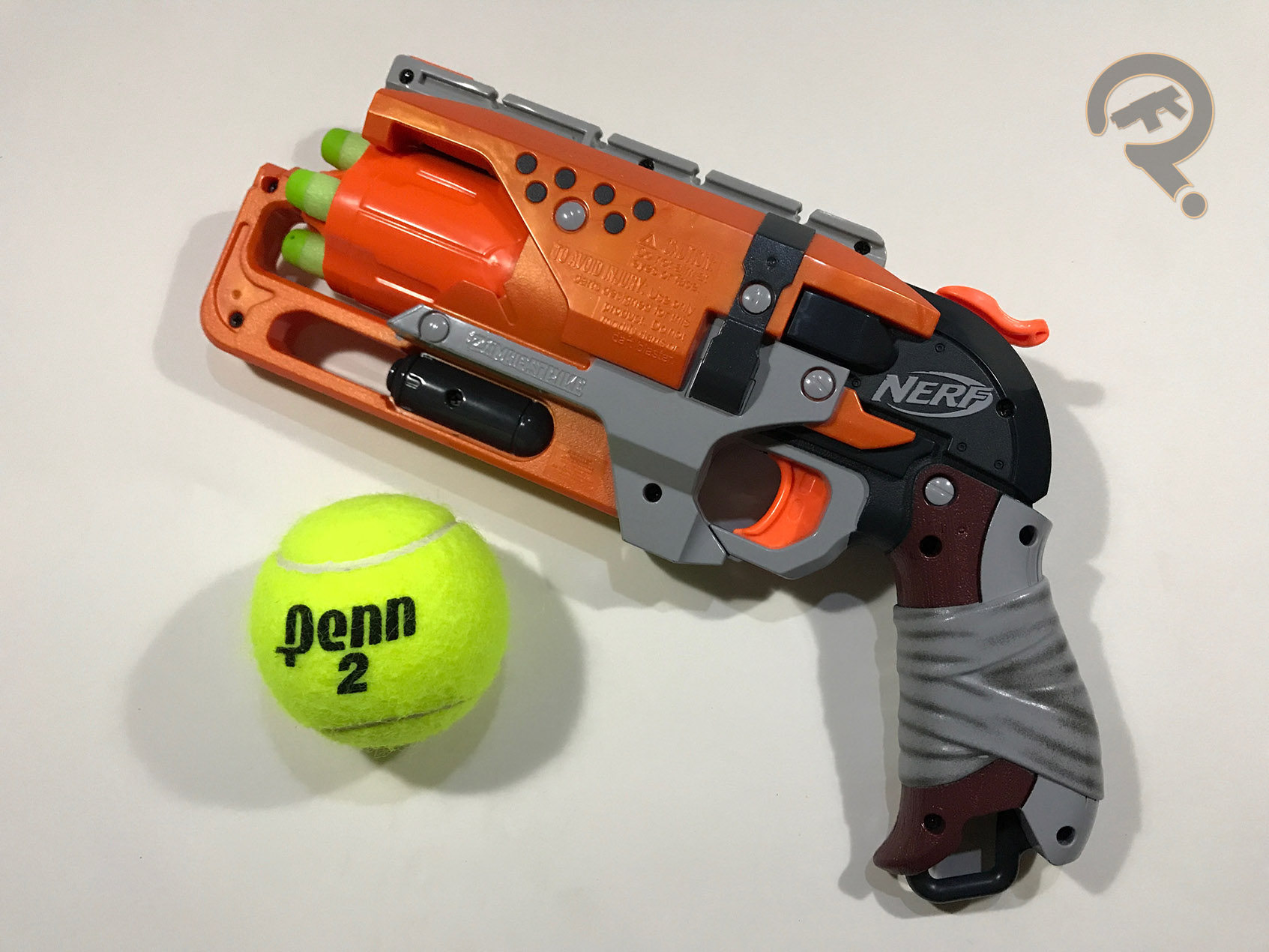
The Hammershot was one of the very first Zombie Strike blasters, released in 2013 alongside the Sledgefire.  The Hammershot is a 5-round revolver style blaster, which, itself is nothing new.  What sets the Hammershot apart from other blasters like the Spectre REV-5 or even the Strongarm is its priming mechanism.  Instead of a traditional priming slide which would require a second hand to operate, the Hammershot uses, unsurprisingly, a hammer style of prime that can be operated entirely one-handed.  If you read my previous review, you’ll know that the premise of effective dual-wieldable blasters is quite alluring to me, so it should come as no surprise that I own a couple of these, thanks in part to my boy Ethan.  The outer shell of the blaster is entirely original work and has a lot of really nice layering of plastic which gives it some visual depth.  This is also helped by the use of this super cool, very subtle swirly metallic orange plastic which I believe is completely unique to this blaster.  There’s some interesting texture work going on too with the faux wood grain and faux cloth wrap on the handle.  I was skeptical of the cloth wrap at first because I thought it looked goofy and sort of out of place, but ergonomically it works just fine with no harsh lines or edges.  The handle itself is rather long, extending well past the bottom of my hand, but the extra length does provide a nice amount of surface to grip while working the priming hammer with your thumb.  As something of a side note, the distribution of weight around the trigger as well as the larger grip make it very easy and entertaining to spin the blaster around your index finger like a gunslinger.  In doing so, I’ve managed to fling mine into the floor several times without so much as a scratch, which speaks to the build quality of the blaster.  This is probably largely due to the relative simplicity of the internal mechanisms and outer construction.  Unlike blasters such as the Spectre, the Hammershot has no barrel or stock attachment points though it does have a single attachment rail along the top of the blaster.  The blaster performs admirably with shots flying far and hitting with substantial force.  I would recommend it more for outdoor play and advise caution before using it to light up your younger siblings unannounced.  The Hammershot comes packaged with 5 Zombie Strike green Elite darts.

THE ME HALF OF THE EQUATION

When the Zombie Strike line was first announced, for me, the Hammershot took the back seat as far as my attention goes.  There had been more than a handful of revolver blasters over the years and the premise of the shotgun style Sledgefire overshadowed the Hammershot.  While it’s true the Sledgefire may be the more mechanically interesting of the two, it’s hard to deny the sheer utility of the Hammershot.


The Blaster In Question #0020: Voidcaster

VOIDCASTER

ALIEN MENACE

If I had to attribute my love for toy blasters to one thing, it’s wanting to recreate my favorite video games in real life, one of the most notable examples being the Halo franchise.  These two were brought together a couple years ago when Mattel gained the Halo license for its BoomCo line of blasters.  The thing is, while trying to create accurate replicas of the in-game weapons while also fitting them around recycled, but mostly functional mechanics, they ended up being pretty disappointing, not really doing a good job on either front.  Cue Hasbro who launched the Alien Menace Nerf line, seemingly as a direct counter to Boomco’s Halo branded products.  I’ve already reviewed the Ravager from the series, but today I’ll be taking a look at one of the line’s brand new additions, the Voidcaster.

THE BLASTER ITSELF

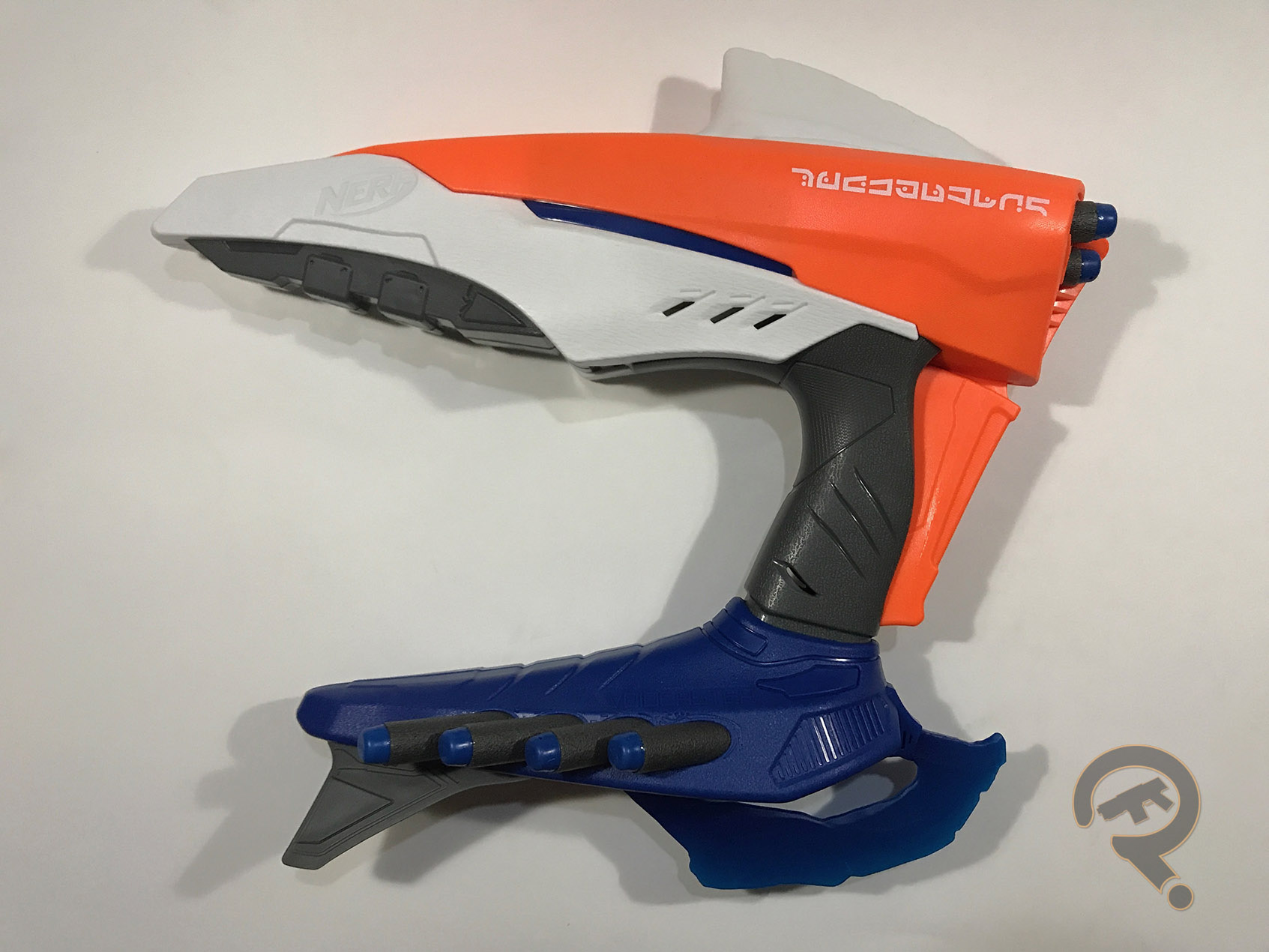
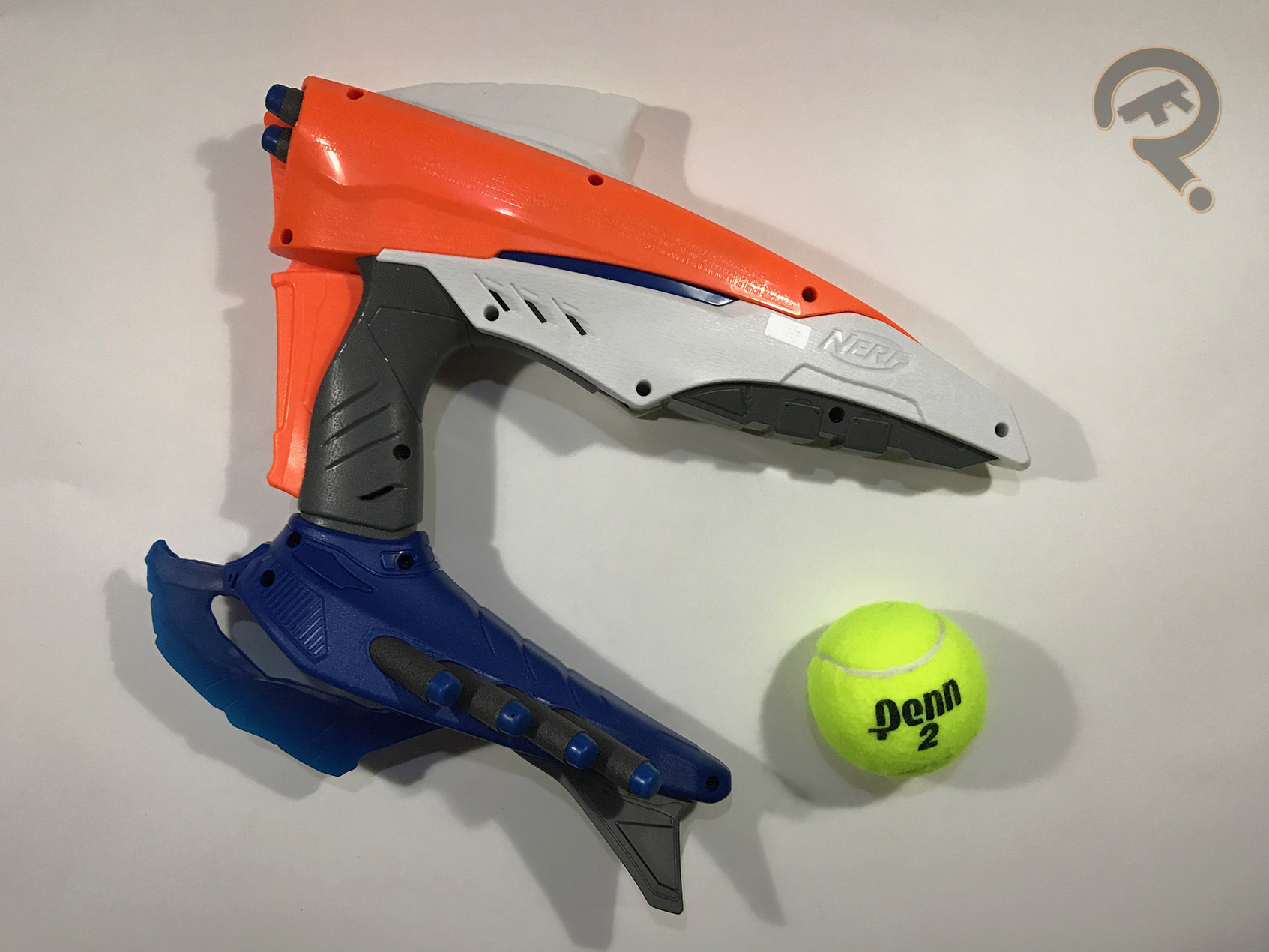
The Voidcaster was released in 2017 as part of the TRU exclusive Alien Menace line.  If you’ve read my review of the Ravager from the same line, you’ll know that one of the blaster’s highlights were the amount of fine detail and texture work put into the shell.  The same is true for the Voidcaster which sports faux ray skin, bone, and even crystalline elements throughout it’s uniquely molded shell.  Internally, the Voidcaster borrows its primary mechanism from the Snapfire 8 of the Dart Tag line.  Unlike most other blasters, the Voidcaster does not require batteries nor does it need to be manually cycled between shots.  The large trigger —which takes up almost the entire length of the grip— uses its long pull to push the plunger back, releasing it once the trigger has been compressed fully.  Aside from using stored air pressure in a tank, this is the only way I am aware of to achieve a semi-automatic blaster without the need for batteries.  The blaster has 4 barrels linked via smart AR.  The overall shape of the blaster is reminiscent of the iconic plasma rifle from the Halo series and the 8 dart holders on the bottom portion of the blaster, when fully loaded, resemble design features of the needler from the same games.  The blaster feels solid in the hand but it does suffer from a lack of secondary grip points, making one-handed firing practically the only option, however, the semi-auto nature of the blaster means that dual wielding is not a problem.  Accuracy is a bit of a weak point for the blaster.  By extending the trigger down the front of the grip, compressing the spring is much easier than with a single finger trigger, but it also means the blaster jostles around a fair bit when firing, more so if firing in rapid succession.  Because priming the blaster relies on the grip strength of the user, and because it is a toy for children, the spring driving the plunger is not especially strong and as such, power and distance are noticeably sub-par compared to more conventional blasters.  This is definitely an indoor blaster and if you can manage to get your hands on two of them, I highly recommend dual wielding for busting into your younger siblings’ rooms and blasting away.  The included darts are a little frustrating for someone like me who has to keep blasters with the darts they are meant to use.  In this case, given the 4 barrels and 8 dart holders on the blaster, I would have like it to include enough to completely fill all available spaces, but sadly it only comes packaged with 8.  Additionally, the previous 2 Alien Menace blasters came with darts that had grey bodies and purple tips.  The Voidcaster’s included darts are grey with blue tips and, as of me writing this, are the only ones with this color scheme.  Available Alien Menace dart packs only feature purple tips.
THE ME HALF OF THE EQUATION

I was very excited for this blaster since it was announced in Nerf’s pre-Toy Fair press release.  Between then and now, though, there had been basically no word on it.  I was caught quite off guard when I found it at a TRU in South Carolina, so much so that I bought it then and there without a second thought.  It’s a really fun snappy little blaster with some really cool aesthetics, and it’s only enhance by the addition of a second for your other hand.