RUST LORD
FORTNITE (JAZWARES)

Oh man, let me tell you guys, today’s review? It’s totally lit. Like, it’s at peak levels of on-fleek-ness. This review here? It’s cool AF. This is about the dankest review you’re ever gonna read. I’m finna about to review this boi, which, I assure you, is not empty. Yeet. Stick with me fam, things are about to get hella turnt! …am I doing this right? Is this how we talk about the Fortfight? I’m sorry, I don’t have the 411 on what’s hip these days. But, in an effort to get home with the downies, I got one of these here Fortniters to review. Swag.
THE FIGURE ITSELF
 So, homeslice here is Rust Lord, an absolute unite, who is one of the many available skins in Fortnite. He’s a part of Jazwares Fortnite line, available exclusively in the “Llama Drama Loot Piñata” pack, which was the first item available from Jazwares’ line, first showing up on shelves at the beginning of the month. The figure stands just shy of 4 inches tall and he has 28 points of articulation. Stylistically, Rust Lord is very similar to Hasbro’s 25th Anniversary GI Joes, though perhaps a bit heftier. He’ll fit in pretty well, though. What surprised me most about this figure, though, was the articulation, which honestly is a bit of a step-up from the Joes, and even rivals the likes of Marvel Legends, but at a smaller scale. Despite all of this articulation, the construction of the figure is still really solid, and he’s not flimsy at all. Rust Lord’s design is definitely one that lends itself pretty well to a toy. The figure changes up a few proportional elements, in order to make for a better translation to toy, but he’s actually pretty close. The sculpt is clean and pretty sharp, which is honestly a fair bit better than I’m used to seeing with figures at this scale, even from the likes of Hasbro. The paintwork for Rust Lord is fairly
  cleanly handled. It’s pretty striking, and, like the sculpt, it will help him to match alright with Joes. There are a handful of unpainted details here and there, but for the most part, he gets the job done. Rust Lord himself only makes up a small piece of what’s included in the Loot Piñata. There are also a whopping ten weapons*, four backpacks, and eight building plates. For weapons, he has an assault rifle, bolt-action sniper rifle, drum gun, grenade launcher, legendary assault rifle, legendary burst assault rifle, light machine gun, pump shotgun, rocket launcher, and suppressed submachine gun. Some of the
  sculpts are a little cartoony for my taste, but they’re mostly pretty solid pieces, and, like the main figure, they should do well arming your Joes and the like. For the backpacks, he has the Bright Bag, Cuddle Bow, Satchel, and Scaly. The satchel’s the only one that really matches up with the figure, but the options are nice nevertheless. Lastly, there are the building plates. Two sets of four line-up for some graffiti, and can be configured into all manner of different structures.

THE ME HALF OF THE EQUATION
This is all Max from All Time’s fault. A couple weeks ago, he told me about this set, showed me a few pictures of his and said “it’s kind of like G.I. Joe,” which was enough to sell me. I’m an easy mark, I guess. As someone with absolutely no experience with Fortnite, these figures weren’t even on my radar. Doubly so when I found out they were produced by Jazwares, a company that I generally find to be the toy world’s equivalent of a yawn. This figure has no right to be anywhere near as cool as it is, but I’ll be damned if this isn’t one of the coolest, most solidly crafted figures I’ve picked up as of late. I’ve still got no attachment to Fortnite, but I’ll definitely be finding a spot for this guy with my Joes.
*My set actually had 11 weapons, thanks to me getting an extra drum gun in my set. One of those few times an error totally worked out in my favor.




 People that know me know that I spend more than a fair bit of time playing Warframe. And if, like me, you too play more Warframe than you should, you probably know that the Soma rifle from the game is a boss and I’ll fight you if you don’t like it.
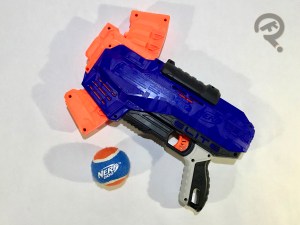 The Rukkus ICS-8 was released right at the end of 2018 as part of the N-Strike Elite series of blasters. It is yet another entry into the list of ratcheting clip-fed blasters like the Battlescout but this time the clip feeds vertically rather than horizontally. Additionally the clip on the Rukkus is curved slightly and is not removable from the blaster. It holds 8 rounds and is capable of slam-fire. The blaster also uses a top priming slide rather than a pump grip or bolt. This isn’t unusual for a smaller Nerf blaster at all but it does play into my next bit so sit tight. If recent news has told us anything, it’s that Nerf is not shy about license deals with upcoming products for both Overwatch and Fortnite. At this point, I would like to submit for consideration, Nerf Warframe. Just extend the clip, put a stock and proper barrel with maybe a pump grip, and you have a decent analog for the Soma, at least in form. Hasbro, if you’re listening, just think about it. Anyway, the Rukkus has no
  attachment rails or lugs of any sort so, sadly, your options for customization are essentially nil without getting into mods. Personally I start with a Hornet Strike and Pistol Gambit to boost the critical- wait… different mods, sorry. The ergonomics of the Rukkus are decent, nothing really remarkable but it’s all comfortable and functional. Likewise, performance is solid without being mindblowing. There are some shots that feel like they don’t hit quite as hard as others but it’s not consistent so it’s hard to nail down what the cause is.





 The Figure In Question