THUNDERBLAST
N-STRIKE
 I’m sure quite a few if not most of you are familiar with the KISS acronym meaning “keep it simple, stupid” or some derivation of that. Well this week’s blaster deals with the slightly lesser known KISBJUOOTFBDYEHS acronym. And if any blaster can demonstrate keeping it simple by just updating one of the first blaster designs you ever had, stupid, it’s the Thunderblast. So let’s have a look.
THE BLASTER ITSELF
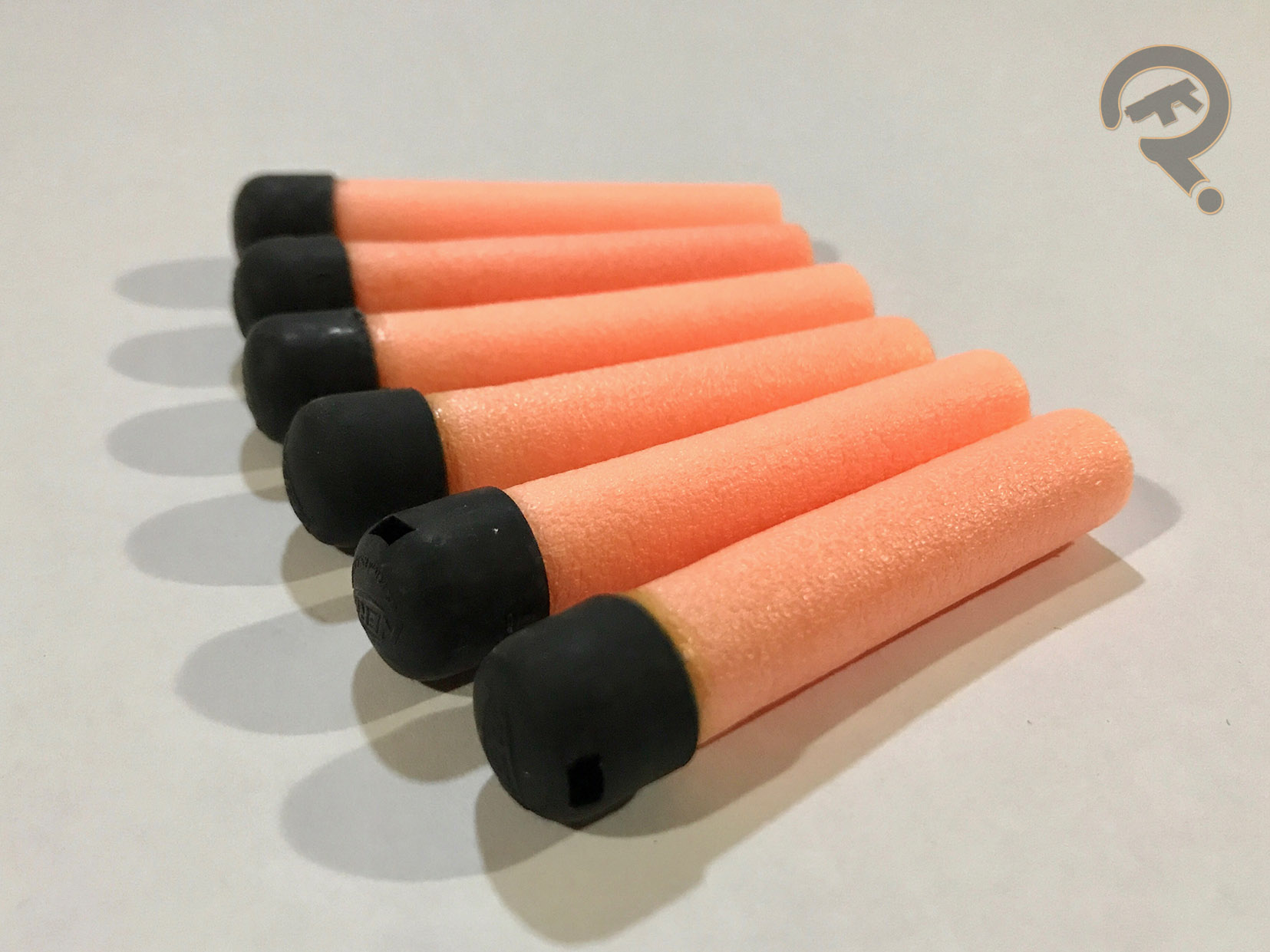
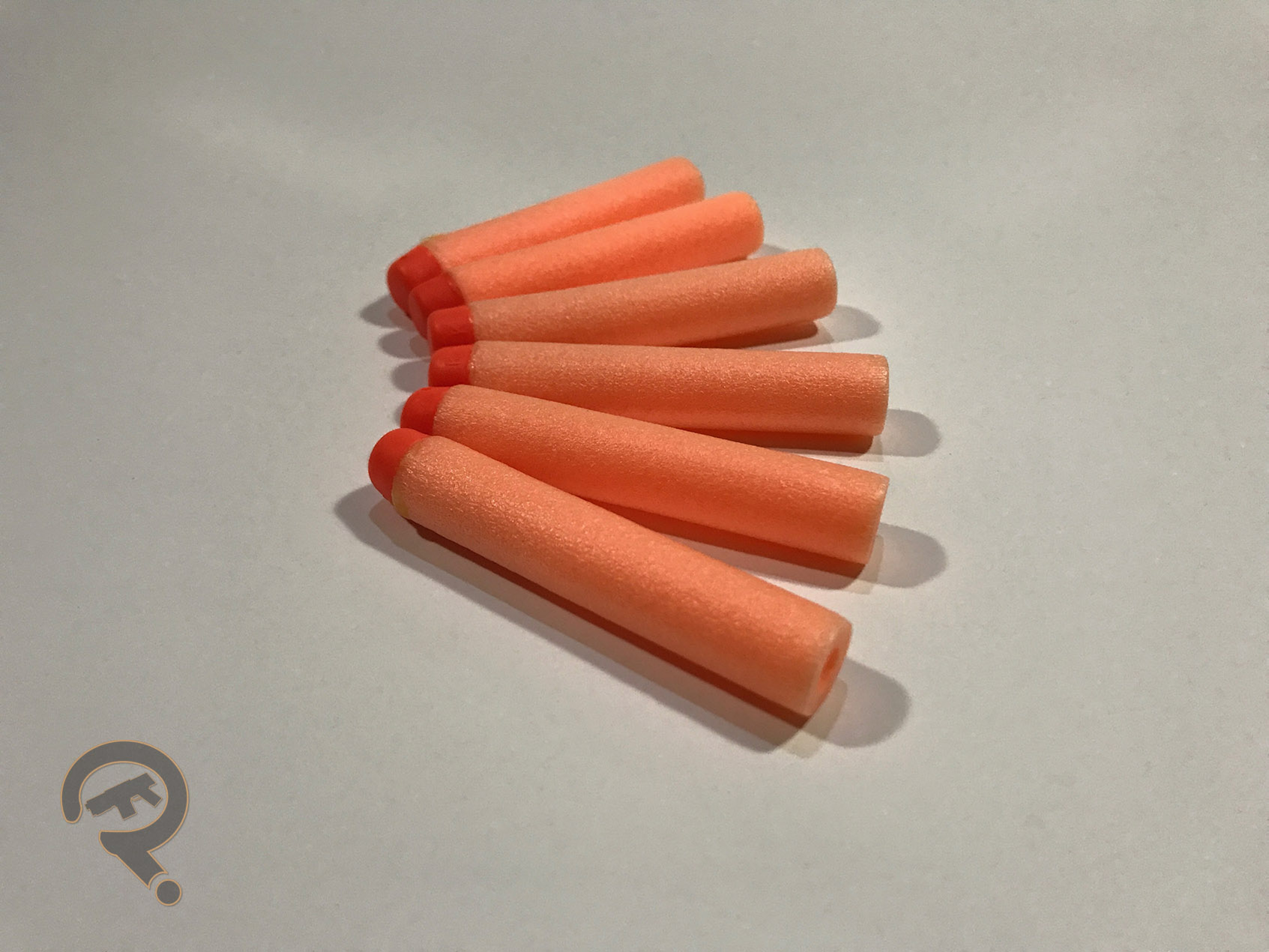
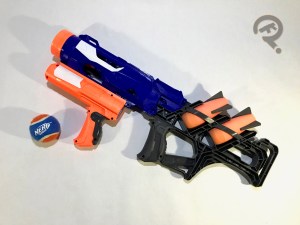 The Thunderblast was released in 2015 as part of the N-Strike line. I know it’s got the Elite style blue and white color scheme, but the box just says N-Strike, no Elite here. It uses possibly one of the simplest firing mechanisms ever used in a Nerf blaster, a system referred to as a HAMP or hand-actuated manual pump, I think. In essence, you load one of the rockets onto the spindle, push the fore-grip forward and slam it back as hard as you can. The harder you slam, the more power behind the rocket. Of course, the act of vigorously slamming back a fore-grip will do terrible things to your accuracy, but we’re talking about Nerf here, how accurate can you possibly be? This system, albeit in a very different form factor, is virtually identical to the system in the very first Nerf blaster I ever owned, the NB-1 from 1992 back when Nerf was made by Kenner, and even then, the design was used on earlier toys like a foam Batarang launcher. Bet you weren’t expecting a Batman name-drop in this Nerf rocket launcher review. Coming back to the Thunderblast, while the mechanics on the inside haven’t changed much, I am glad they changed the ergonomics. While the NB-1 will always have a special place in my heart, if I’m honest, the grips on that thing are small and blocky in contrast to the TB’s large contoured grips, even allowing for vertical or horizontal fore-grips. The TB also has a stock, something it has over the NB. Granted it’s not the best stock, but it’s fine. There’s a curved section on the underside that’s meant to allow you to seat the blaster up on top of your shoulder like a proper rocket launcher, but what this does is reduce the length of pull so much that your dominant arm ends up sticking out to the side like an awkward chicken wing. The thought is still appreciated. You can shoulder the blaster like a rifle, but the way the extra rockets are stored means you’re basically shooting from the hip from your shoulder… kind of. I’m trying to say they block any kind of aiming you might attempt. Performance is all over the place, given that the power behind each shot is fully dependent on the user, but overall, if you’re at least of teenage years with average upper body strength, you should be able to launch rockets pretty far. Interestingly, because the rockets are so wide, even a jacked up shot from the tuberculosis doesn’t hurt as much as a standard shot from an Elite blaster, but it your younger siblings don’t know that, just the presence that a rocket launcher has can be quite effective for intimidation. And that’s something the New Balance didn’t have. The consumption comes packaged with 2 rockets. I know in my pictures it has 3 but I think it looks better with 3.
THE ME HALF OF THE EQUATION
I fully accept that at this point, a blaster like the Thunderblast isn’t exactly practical, but the homage to older designs does appeal to me. That and the fact that it’s a rocket launcher. It did kind of bum me out initially when I saw it didn’t have a trigger, but if we’ve learned anything from the Modulus Mediator barrel, it’s that Nerf still knows how to do pressurized air blasters, so who knows? Maybe we’ll see a revamp of the Titan one day.
 Knife-wrench: its a knife and wrench, mostly wrench. And then he accidentally stabs himself in the leg and we all have a good chuckle. That reminds me of this week’s blaster. No, not the stabbing part, but being a weird combination of two things, namely being a rifle and a pistol. Now that I’m thinking about it that’s hardly a unique design feature for this blaster, but I made a Scrubs reference, what do you want?
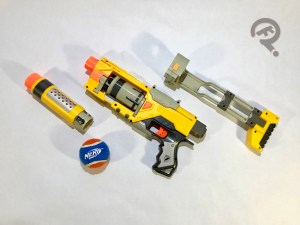 The Spectre was released in 2010 as part of the original N-Strike line, then again in 2013 as the Elite version. I do own both versions, but I didn’t have the Elite model on hand when I was taking photos, so just keep that in mind. Most stuff I’ll touch on applies to both blasters but I’ll point out any differences. The Spectre is a 5 shot revolver style blaster similar to the Maverick or Strongarm, but with slightly lower capacity. The shell of the original was all new and the only changes to the Elite version besides color are the slots in the sides of the body for the slide to interface with the internals. The cylinder swings out to the left side of the blaster, which, itself, sports a barrel lug, a stock lug, and an accessory rail. At the time of its initial release, what set the Spectre apart from other pistols was its ability to accept barrel extensions and stocks, like those included, to transform it into more of a rifle type blaster. As I recall, the
 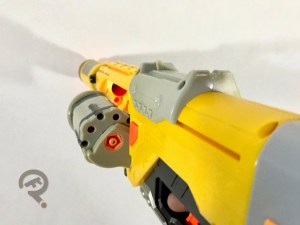 accessories that came with the Spectre were perhaps more highly sought after than the actual blaster. First off, the stock, while kinda flimsy, was the first example of a side folding stock to hit the market, so that was cool. Also, the barrel had the double distinction of having a bore wide enough that it wouldn’t affect performance, and it looked like a cool suppressor. The ergonomics of the blaster are pretty standard, functional but not mind blowing, though having both attachments on does make it feel like some sort of covert scout rifle, which is fun. Performance on the Elite version is substantially improved over the original but neither version is all that great, to be honest.
 Just about everyone has at least heard of the Stryfe or the RapidStrike or Modulus ECS-10.
 The Barricade RV-10 was released in 2010 as part of the N-Strike line, kind of the only line Nerf had going at the time.
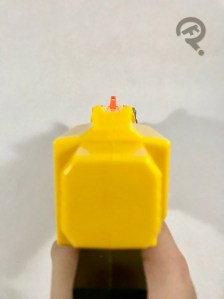 variant- I mean, the Elite version, which came with a stock and was renamed the Stockade.
 The Vulcan EBF-25 was released waaaay back in 2008 as part of the original N-Strike line. No Elite here. The whole thing is just… I mean, it’s a machine gun. What more do you want? Instead of using a magazine or rotating cylinder, the Vulcan actually uses a belt to feed darts into the action which, itself, can be operated in two ways. The primary method being full auto because come on, it’s a machine gun. Provided you had installed the 6 D cell batteries in the tray, you could then load in the belt, flick the switch just above the firing grip, and hold the trigger down making the blaster fire repeatedly with a rather noisy “wheeee-CHUNK! wheeee-CHUNK! wheeee-CHUNK!” While it was technically full-auto, the rate of fire was not exactly impressive. With good coordination, you could easily out-pace it by cycling the bolt manually which had the added benefit of not requiring the aforementioned 2 cubic tons of batteries to work. You could, in theory, run the blaster entirely without batteries. Just leave them in a little pile over there… just 2 cubic tons. While it undoubtedly made the internals of the blaster a lot more complex, it is a feature I’m disappointed didn’t make it to later electronic blasters like the Stampede. The ammo belts, I feel a little differently about. There is a certain level of novelty in using a legit ammo belt in a toy blaster, but man, are
  they a pain to reload. Maybe if there had been another blaster that also used the same belts, I might like them a bit more, but the novel factor goes away after the third or fourth time you have to reload the dang things. It’s not just a matter of putting the darts back, when the belt is emptied, it falls out the right side of the blaster, or if you want to reload without firing off all 25 shots, you need to pull the remaining belt out of the action in order to reset it. Once you have a loaded belt, there’s still the process of setting it in the ammo box attached to the left side of the blaster in just the right way that the feed gear can actually pull the belt into the blaster, and THEN you have to open the top hatch on the blaster body to seat the first link onto the feed gear, close everything up again and prime the bolt. Once you’ve done all of that, now you can shoot. BUT WAIT! Now you have to decide, are you going to carry the blaster by hand and fire from the hip like some kind of sexual tyrannosaurus, or are you going to mount it on the included tripod, realize the tripod kinda sucks, and opt for the Blaine method anyway? But what does Mr. “The Lovebird” Ventura have to say about that body? Probably something rambling and largely incoherent about having to keep him away from it, but it’s worth noting that the Vulcan has all original sculpt work which includes a
  hinged top handle for use in the “Old Painless” style of carry and a detachable ammo box for holding the belt while in or out of use. The front end of the Vulcan also sports 3 Nerf accessory rails, but I can’t honestly think of what you could possibly want to put on them. There are, in fact, a set of sights along the top of the blaster that you’re welcome to use if you think it’ll help. Sadly, these days, the Vulcan doesn’t quite stand up to other blasters in terms of range or power. If you play your cards right and rely mainly on the shock value of busting into your younger siblings’ room holding this, they might not even notice that the shots aren’t hitting very hard. The Vulcan comes packaged with the tripod, the ammo box, two belts, a sling which I have since lost, and 50 whistler micro darts.




 The Figure In Question