SUB-MARINER
MARVEL LEGENDS (HASBRO)

“With incredible strength and swimming speed, Sub-Mariner is a powerful force on land and sea.”
Patience is a virtue. There’s a phrase that holds a lot of weight in the toy collecting world. Be it waiting for an announcement of a certain character, waiting to see a prototype, waiting for the figure to make it to retail, or even waiting to find that figure. Sometimes, it’s the waiting for a specific version of a character that gets you, though. Take for instance, the Sub-Mariner, Marvel’s oldest super hero, who has spent the vast majority of his almost 80 year career in a green speedo. And yet, in 15 years of Marvel Legends, we haven’t gotten a proper speedo-ed Namor.* Kind of crazy, right? Well, that’s finally changed.
THE FIGURE ITSELF
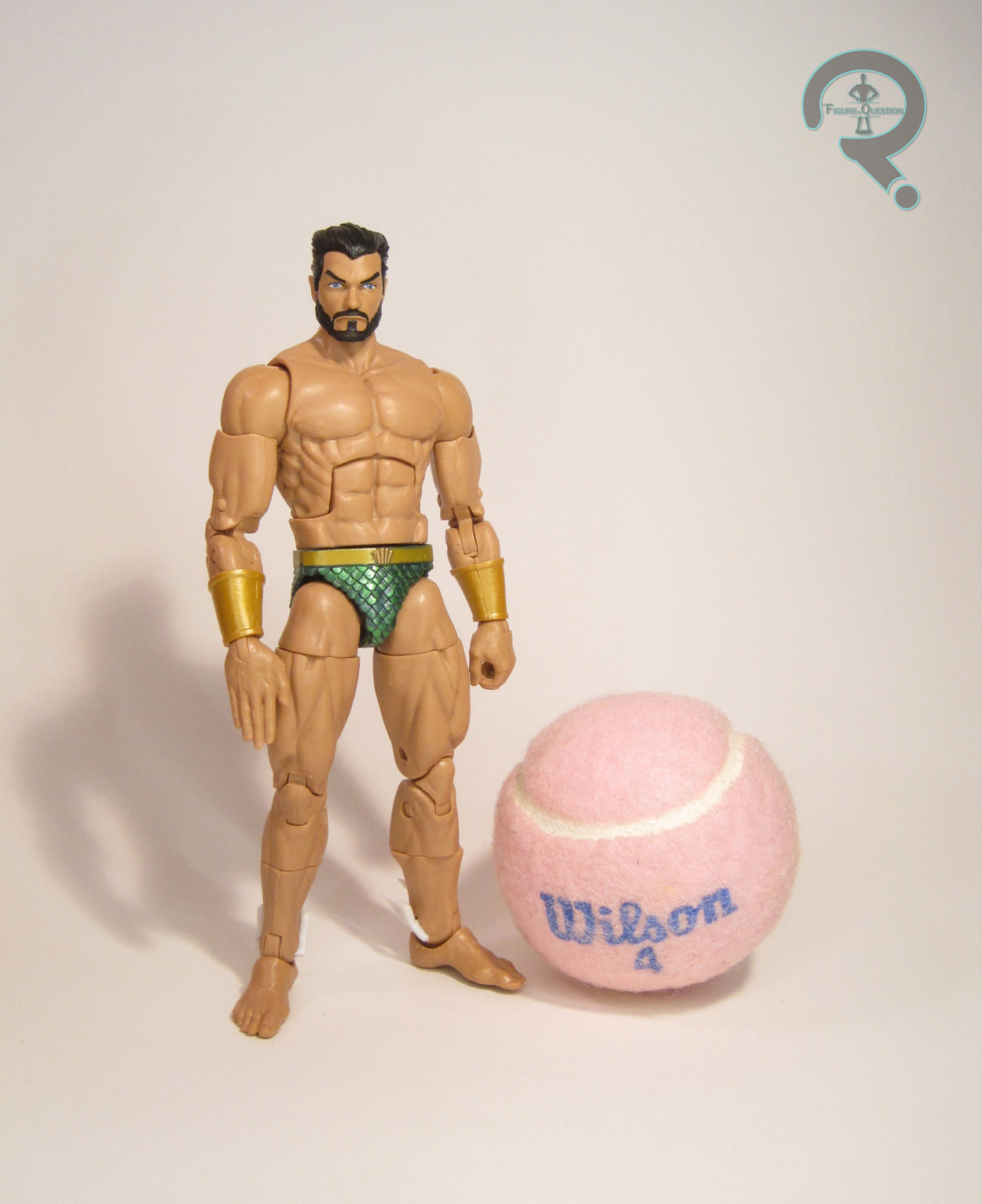 Sub-Mariner is part of the recent Okoye Series of Marvel Legends, as one of three comics-inspired figures in the assortment. As with Black Bolt, the presence of Namor in what’s ostensibly a Black Panther assortment is a little baffling, but I’m hardly going to argue with any logic that finally gets me a classic Namor. The figure stands 6 1/2 inches tall and he has 32 points of articulation. Like his Walgreens-exclusive predecessor, this Namor is built on the Reaper body, and makes use of the shared Namor/Wonder Man wrist bracers. He also uses the shins from the last Namor, allowing him to keep his signature ankle wings. On top of all that, the figure gets a new head, torso, pelvis, and feet. I had honestly expected the figure to just use the same head as WG Namor. While that head has a few issues, I thought it was pretty serviceable, certainly enough for Hasbro to keep using it. Hasbro thought otherwise, and instead gave us an all-new sculpt that rivals the old TB Namor in terms of perfectness for the character. This is Namor, no doubt about it. The hair’s got that perfect square shape, his eyebrows are arched just the right way, and he’s got just the right amount of pomposity. I expected the torso to be at least slightly tweaked, so that Namor wouldn’t go totally nipple-less, but I was happy to see Hasbro went for a total re-sculpt, so as to keep him consistent with the slightly slimmer build of the WG Namor. The pelvis is another case of a surprise new piece. Given the scales on the last figure (and the recent Vintage Captain America) release, I was entirely expecting for those to be painted on. It’s awesome that they weren’t, and adds a lot to this figure, keeping his sculpt from being as devoid of detail as it could have been. Lastly, there are the feet. They’re pretty straightforward, but well sculpted nonetheless. The paint on Sub-Mariner isn’t super complex, but it’s all pretty great. The details are all nice and clean, and the metallic accenting on the speedo certainly pops. They’ve changed the skin tone since the last figure, which is a bit of a bummer if you wanted to swap heads, but it’s not terribly different. This is also more consistent with Namor’s usual palette. The figure is packed with an extra bearded head, which more closely resembles the prior Namor, to the point of almost looking like a different person. He’s also go the same two pairs of hands, as well as his trident. I was happy that he got a proper trident this time; Odin’s spear just didn’t cut it last time. This one’s awesome. Lastly, Namor is packed with both of Okoye’s arms.

THE ME HALF OF THE EQUATION
After the surprise of finding Black Bolt at Walgreens, I was pretty much immediately on the lookout for this guy. I was not alone in this endeavor, evidently, and Namor was the notable exception pretty much every time I saw the assortment in stores. I found Namor almost by accident, really. He was at a Target I check on a fairly regular basis; I’d stopped in to look for him with no luck, so I bought some Black Series figures I’d been looking for instead. I ended up needing to stop by for something else the next day, and just walked down the toy aisle, not really expecting to find anything, and there he was. Yay. I really like this figure. A lot. He’s the Namor I’ve been waiting for pretty much since Marvel Legends started. Now I have him, and I’m content with my Namor sub-set of my collection.
*Yes, I know Hasbro put out a speedo-clad Namor in 2007’s Ronan the Accuser Series, but cutting straight to the point, that figure sucked. The less said, the better.



 Sometimes, it is pretty clear when Hasbro, and more specifically Nerf, take criticisms to heart and fix problems with their products. The Recon Mk.II comes to mind. Other times, it seems more like they hear the criticism and offer a solution that isn’t exactly what people had in mind. One of the most widespread gripes about Nerf lately is their tendency to only paint one side of a blaster, leaving the design lopsided. I can’t help but feel they heard this and said “You don’t like how we paint our blasters? Well how about we just don’t?” Introducing the Surgefire. Ok, there’s more to it than that, but I just had to get it out of the way. On to the review!
 The Surgefire was released in 2018 as part of the core N-Strike Elite series. It operates on a pump-action revolver design that holds 15 darts in the cylinder. It’s hardly the first time we’ve seen these mechanics used in a blaster. I suppose if you wanted to make the leap, you could say it’s an update to the Furyfire from the old Dart Tag line, though most people go with calling it the Elite version of the MEGA Rotofury. Both descriptions work. The shell is all new work and features one Nerf attachment rail along with some pretty interesting body detailing. The dark grey area just above the trigger assembly actually has the word “Elite” carved out of it revealing the blue plastic underneath through the letters. The use of dark blue text sunken into a dark grey panel does make it probably a little more subtle than they might have intended, but I do like that it suggests more intricate builds and sculpts to come. This also plays into the aforementioned lack of paint, save for the Nerf logo and the name “Surgefire” above the barrel. All variation in color is achieved via layering and inlaying separate pieces of plastic. It does lend itself to a higher quality feel to the blaster over something that might rely on paint or decals. Overall, the style is
 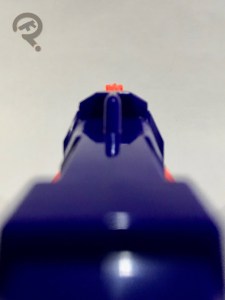 pulled off pretty well with just a couple drawbacks. First and foremost is in the pistol grip. Along the front seam where the two light grey halves meet, the screws are placed just far enough that the plastic can flex and produce a hard edge where it splits. At the best, its abrasive over time or if you’re holding onto the blaster tightly, and at worst it can actually pinch my fingers. It seems like adding another internal support wouldn’t have been too much trouble so it’s irksome to find it absent from the design. Ultimately it’s a minor complaint, and my second complaint is even more so. I’ll sum it up here: “By the goddess, that’s a lot of orange in one place.” Yes, it might have been nice to see some other colors on the front end, but it is what it is, I guess. Barring the issue with the grip, the blaster feels good in the hand. It’s stout but solid, giving it a sort of combat shotgun kind of feel. I do wish the cylinder could be loaded from the rear and that the ratchet on the cylinder could be indexed by hand a little easier, but ultimately it’s functional so I can’t really complain. For all its petty aesthetic and operational quirks, the Surgefire actually makes up for most of it in performance. Shots feel like they have more energy behind them than a lot of other recent blasters, flying far and hitting hard. You should really think about whether or not your younger sibling has earned it before you bust into their room and open fire with the Surgefire. Not as much as with, say, a Rival blaster, but more than just popping them in the head with a Jolt. The Surgefire comes packaged with the cylinder which snaps into the blaster and 15 Elite darts.


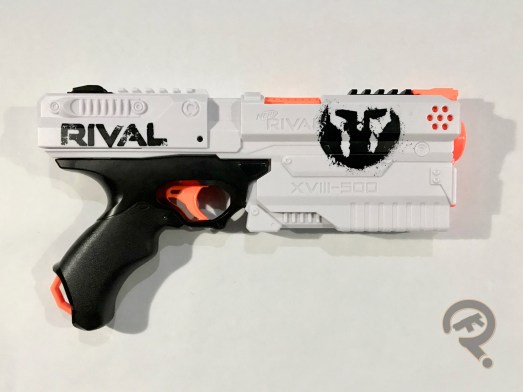 “Hang on a minute, didn’t we just have a Rival review, like, two weeks ago?” I hear you ask. Why yes, sharp-eyed viewer, indeed we did. Ordinarily I’d try and spread stuff out and keep you guessing about what the next blaster will be, like a game, but this is new and hot. The new hotness, you might say. So this week I’m looking at the Kronos. Something that bears the name of the father to the Olympians must be a behemoth of a blaster, right? Actually, it kind of goes the other way, but trust me, it’s not the size that counts, it’s all about the balls.
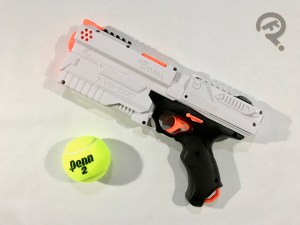 The Kronos XVIII-500 was released in 2018 as part of the Phantom Corps subset of Rival blasters. I was initially under the impression that Phantom Corps was a Target exclusive line, but this blaster was purchased from TRU which confounded me to no end, at least for a few minutes. No idea what the deal with that is but whatever, you’re here to read about the blaster. The Kronos is a spring powered pistol with a 5 round integrated magazine à la MEGA Magnus or Star Wars Rey (Jakku) Blaster. Like both of those examples, the Kronos is loaded through a port on the top of the blaster that opens when the slide is primed back. The Kronos also has an additional flap covering the port which I guess isn’t really necessary but it does preserve the silhouette of the blaster a little bit. The shell of the blaster is all new and sports functional front and rear sights as well as 2 Rival accessory rails, one on the slide and one just above the muzzle. Interestingly, while the blaster is labeled “XVIII-500” on both sides, the name Kronos appears nowhere except on the packaging. Something to note about the rails on the Kronos is that, after attaching the Rival red dot sight, I noticed that it could slide back and forth just a little bit, just a few millimeters at most, and the nature of the attachment mechanism means it wasn’t in danger of falling off, but it’s just something I’d never had
 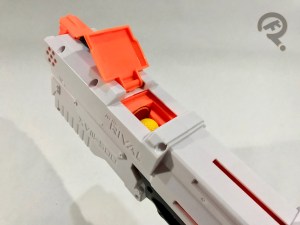 any of my other Rival blaster do. I doubt that’s going to make or break anyone’s opinion of it, though. Aside from that, everything about the Kronos’ construction is solid. The grip in particular is very comfortable and secure in the hand as it follows much more organic lines than the more hard-lined rest of the blaster body, which is a style I quite like, visually and practically. The slide has a surprising amount of thought and engineering put into it. Priming the blaster is fairly easy with the grip panels that add a good amount of traction as well as providing a more defined surface to pull back on. On the underside of the slide, there are a couple of telescoping flat panels that extend when the slide is pulled back, I assume to either keep the mechanism clean or to prevent kids pinching their fingers in the internals. The very rear of the slide also has a cutout so you can see the orange plunger when it’s primed as well as a button to release the lockup if the blaster jams. Like all other Rival blasters, the Kronos has a safety which locks the trigger when engaged. Unfortunately this particular safety has the same after-the-fact addition kind of feeling that the Zeus’ had. It’s hard to describe verbally, but it feels like it’s flexing before it clicks rather than pivoting and is generally unpleasant to operate, not that it’s a necessary feature per se. For its size, the Kronos holds its own surprisingly well against other Rival blasters in terms of performance. Shots fly and hit with the expected Rival accuracy and power, making it a
 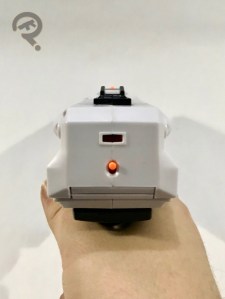 real terror for younger siblings, especially given how low profile and nimble it is due to its smaller size. I’ve even found that it fits rather handily into standard jeans pockets for holstering, just so long as you have jeans with actual pockets (why are fake pockets even a thing? Sorry, side-tracked). The Kronos comes packaged with another set of red and blue Rival flag/ribbon things, provided you got the Phantom Corps version and didn’t shell out $70 for the Deadpool variants, as well as one Rival round- what’s that? It comes with 5 rounds? Ok.. if you say so. Scratch that, I guess it’s supposed to come with 5 rounds. Hmm…