
 TENNIS BALL BLASTER
NERF DOG

I’m not dead! I swear! Turns out my sister having a sleepover can be almost as disruptive to Nerf reviews as having my world exploded. Almost. Not only that, but have a bit of a weird one for you this week. It turns out Nerf makes a whole line of dog toys which mainly consist of the standard chewy footballs and lengths of rope, but also, as it turns out, a blaster. My family does own a dog but she’s not really the playing type, but that hardly stopped me from picking one of these up.
THE BLASTER ITSELF
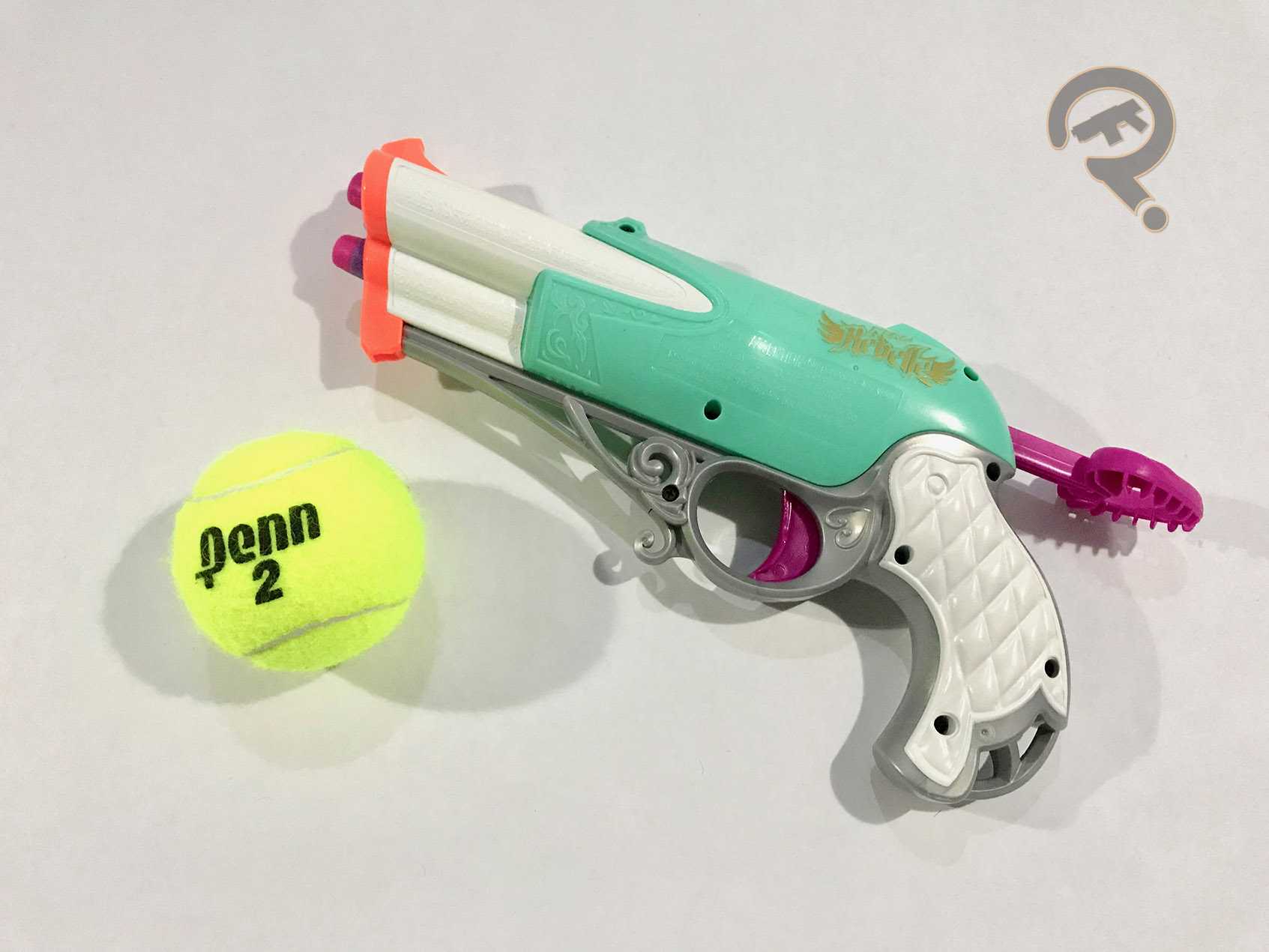
 It’s a little hard to track down the relevant information, but it seems like the Nerf Dog Tennis Ball Blaster was released in 2015 as part of the Nerf Dog line. The mechanism seems to be unique to this particular blaster as it doesn’t use the traditional air pressure to launch the projectile, in this case a tennis ball, but rather just uses the power of the spring inside the blaster to kick the ball out directly. There aren’t any fancy gimmicks or controls, you just load the ball in the barrel, pull the top handle back to prime it and then pull the trigger. The outer shell is completely original too, which isn’t surprising given the rather purpose-built nature of the blaster. The overall feel of the blaster is that its built so that even a non-Nerf savvy person couldn’t mess it up too badly. The construction is hefty and solid and the grip has plenty of surface to hold onto. I get the feeling it’s meant to be fired one handed like a pistol because the front end is very wide to accommodate the ammo type, but this means it’s a bit awkward trying to hold it as you would a rifle type blaster. There is a ball holder on the underside of the blaster for storing the tennis ball when not
  loaded into the barrel. While the ball included is Nerf branded, it is dimensionally the same as a regular tennis ball, so you could use any brand you like. Now, obviously, I can’t tell you to go harass any younger siblings you might have with this blaster. That would actually be abuse. But I can tell you that in the amount of range testing I did, I honestly found the performance pretty disappointing. I’m not athletic, like, at all, but I could easily throw a tennis ball farther than this can launch one. Some of you may be thinking that it’s not meant to be better than a functioning human arm, but it will let people who can’t throw (age, injury, etc.) play with their dog. But then I’d say, if you don’t have the physical faculty to throw a ball by hand, priming back the spring in this blaster is likely to be as much if not more of a challenge. Really, it seems like this blaster is meant for people who like gadgets or are fans of Nerf who also like playing with their dog, that or college kids who want to modify it into a big shotgun for HvZ, but that’s a different story altogether. The Nerf Dog Tennis Ball Blaster comes with an orange and blue Nerf Dog branded tennis ball.
Now, I feel I should take the time to introduce Nerf Dog. Not the product line, the tennis ball. ND will be filling in for Penn for the time being while he’s away on holiday, that is to say, until I figure out where the heck Penn even went. But fear not, for I have it on good authority that ND is exactly the same size and therefore will do a fine job as a stand-in. Who knows, if he does a good job, there might be a more permanent position opening.
THE ME HALF OF THE EQUATION
I wasn’t planning to buy a Nerf blaster when I walked into the local grocery store with my girlfriend. I didn’t even expect to see any aside from the usual array of Jolt reskins. I had seen this blaster online before and thought it looked fun, even if I didn’t have the recommended dog with which to play, but I never bought it until I saw it in person for a substantially reduced price. Most people have impulse grocery purchases like a pack of Oreos or a cake or something. I walked out with an impulse Nerf blaster, because of course I did.



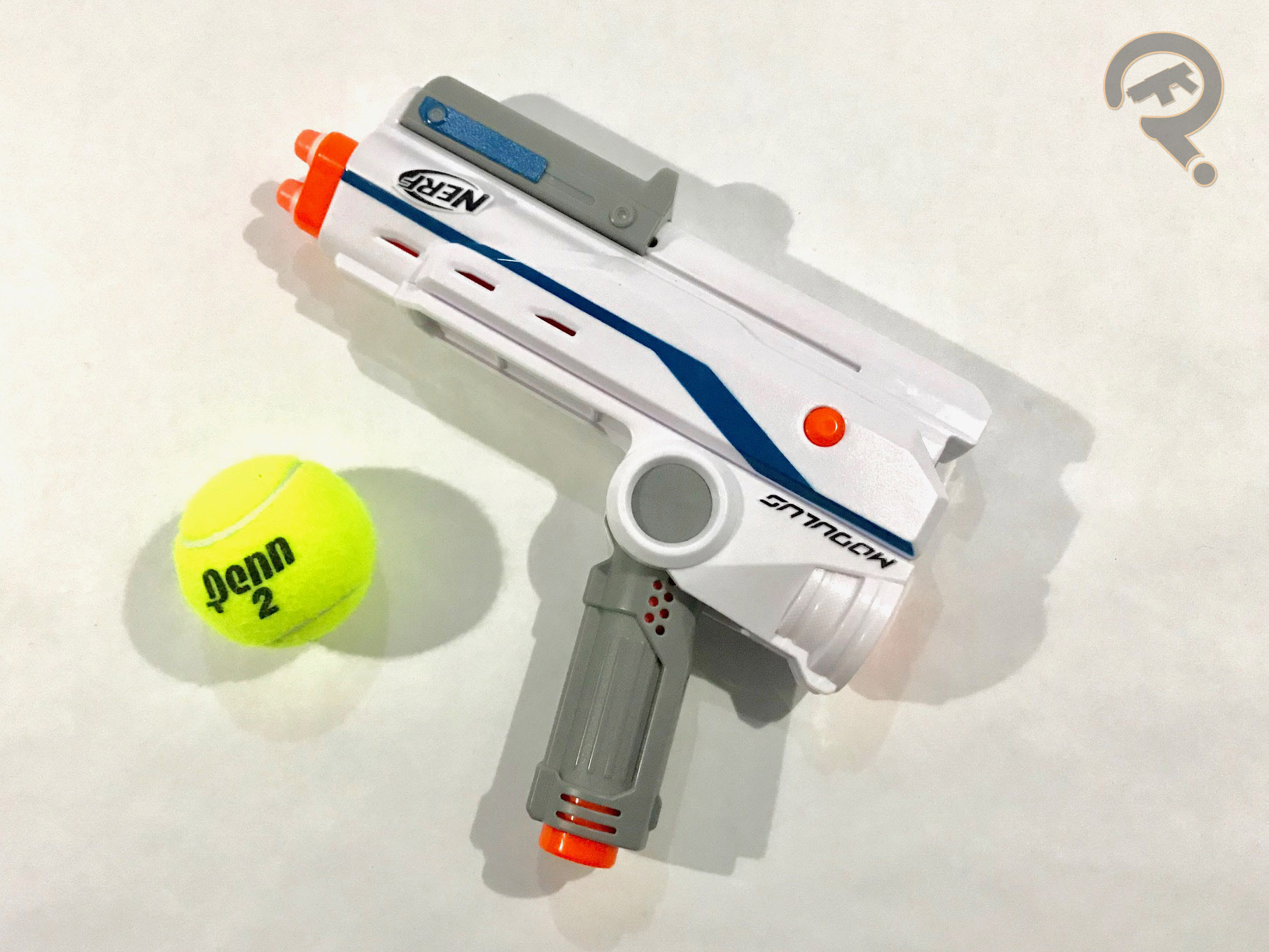
 Sometimes Nerf will announce or unveil a blaster with a particular gimmick to it and all you can do is nod in acknowledgment and hope it at least shoots well. Sometimes it does, but sometimes it really doesn’t. Not to give anything away prematurely, but this week’s blaster is the latter of the two. I’m talking about the Modulus Battlescout. Let’s scope it out.
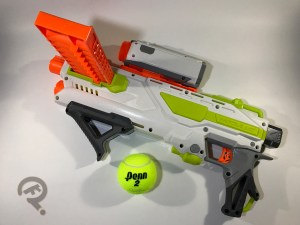 The Battlescout ICS-10 was released in 2016 under the Modulus line and was intended to bring 2 cool new features to the brand. The first was the use of a new horizontally-feeding clip as opposed to the more traditional Nerf magazines (despite Nerf themselves referring to them as “clip systems”). The clip holds 10 rounds and automatically advances one position when the blaster is primed via the angled front grip. This means the clip starts by sticking out the right side of the blaster and eventually ends up sticking out the right side or potentially even just fully ejecting from the blaster itself if you’re a little too vigorous with the pump action. I was reasonably interested in having a Nerf blaster with this style of feeding mechanism when I first heard about it, and I still think it has potential, it just seems like the execution left a little to be desired. The clip is just too bulky for only holding 10 rounds, and the ratcheting mechanism in the blaster doesn’t hold onto the clip very securely so it’s possible for it to get bumped out of position. The second feature the Battlescout was meant to showcase was the included attachable Nerf “action cam” that could clip onto a Nerf accessory rail. I’m pretty sure no one was excited about this. After the Elite Cam ECS-12 blaster, everyone was familiar with the quality of cameras Nerf was working with and they weren’t great. At least the Cam blaster had a screen so you could pretend the camera was just a scope instead of a dedicated recording device. Not so with the Battlescout. I only took a couple test videos just to see what it was like, but the picture quality was dark and grainy, the sound was tinny and sounded like it was being recorded through several blankets, that is, until you tried shooting the blaster while recording upon which you were treated to one of the most
  horrific sounds I’ve experienced as the noise from all the blaster’s mechanical parts moving was transferred through the plastic to the mic. There also seemed to be some discrepancy between the video and audio recording, as every time I played back a recording on the computer, the longer the video went on, the further and further out of sync the audio got. Long story short, the camera was just bad. What was worse, though, was the fact that its inclusion jacked up the price of the Battlescout to almost $70. Yikes, indeed. “But does it shoot well, at least?” I hear you ask. Well, dear reader, no. No it doesn’t. I can’t quite tell where the problem is, but it’s one of the weakest shooting blasters I can recall from recently. Flaccid is a generous term. More than once, I’ve had shots just tumble out of the barrel followed by the slab of orange plastic getting spat out the side of the blaster, sometimes travelling further than the dart. Not great. I can’t say I’d recommend this one for attacking your siblings unless you’ve got enough of a presence that you don’t have to actually shoot to get your point across, because at the very least, the Battlescout looks cool, and with places to attach a barrel, a stock and anything else besides that camera onto the top rail, you can really dress it up. The Battlescout ICS-10 comes packaged with the Camera, a 10-round clip, and 10 Elite Modulus darts.

 Sometimes, it is pretty clear when Hasbro, and more specifically Nerf, take criticisms to heart and fix problems with their products. The Recon Mk.II comes to mind. Other times, it seems more like they hear the criticism and offer a solution that isn’t exactly what people had in mind. One of the most widespread gripes about Nerf lately is their tendency to only paint one side of a blaster, leaving the design lopsided. I can’t help but feel they heard this and said “You don’t like how we paint our blasters? Well how about we just don’t?” Introducing the Surgefire. Ok, there’s more to it than that, but I just had to get it out of the way. On to the review!
 The Surgefire was released in 2018 as part of the core N-Strike Elite series. It operates on a pump-action revolver design that holds 15 darts in the cylinder. It’s hardly the first time we’ve seen these mechanics used in a blaster. I suppose if you wanted to make the leap, you could say it’s an update to the Furyfire from the old Dart Tag line, though most people go with calling it the Elite version of the MEGA Rotofury. Both descriptions work. The shell is all new work and features one Nerf attachment rail along with some pretty interesting body detailing. The dark grey area just above the trigger assembly actually has the word “Elite” carved out of it revealing the blue plastic underneath through the letters. The use of dark blue text sunken into a dark grey panel does make it probably a little more subtle than they might have intended, but I do like that it suggests more intricate builds and sculpts to come. This also plays into the aforementioned lack of paint, save for the Nerf logo and the name “Surgefire” above the barrel. All variation in color is achieved via layering and inlaying separate pieces of plastic. It does lend itself to a higher quality feel to the blaster over something that might rely on paint or decals. Overall, the style is
  pulled off pretty well with just a couple drawbacks. First and foremost is in the pistol grip. Along the front seam where the two light grey halves meet, the screws are placed just far enough that the plastic can flex and produce a hard edge where it splits. At the best, its abrasive over time or if you’re holding onto the blaster tightly, and at worst it can actually pinch my fingers. It seems like adding another internal support wouldn’t have been too much trouble so it’s irksome to find it absent from the design. Ultimately it’s a minor complaint, and my second complaint is even more so. I’ll sum it up here: “By the goddess, that’s a lot of orange in one place.” Yes, it might have been nice to see some other colors on the front end, but it is what it is, I guess. Barring the issue with the grip, the blaster feels good in the hand. It’s stout but solid, giving it a sort of combat shotgun kind of feel. I do wish the cylinder could be loaded from the rear and that the ratchet on the cylinder could be indexed by hand a little easier, but ultimately it’s functional so I can’t really complain. For all its petty aesthetic and operational quirks, the Surgefire actually makes up for most of it in performance. Shots feel like they have more energy behind them than a lot of other recent blasters, flying far and hitting hard. You should really think about whether or not your younger sibling has earned it before you bust into their room and open fire with the Surgefire. Not as much as with, say, a Rival blaster, but more than just popping them in the head with a Jolt. The Surgefire comes packaged with the cylinder which snaps into the blaster and 15 Elite darts.
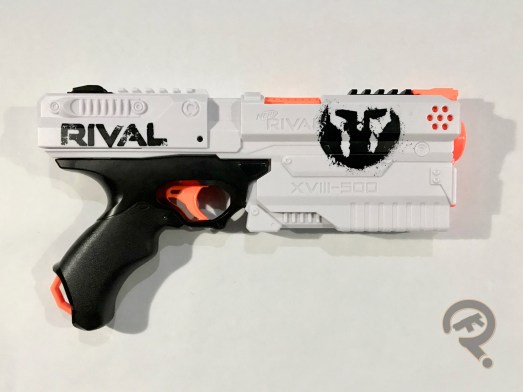 “Hang on a minute, didn’t we just have a Rival review, like, two weeks ago?” I hear you ask. Why yes, sharp-eyed viewer, indeed we did. Ordinarily I’d try and spread stuff out and keep you guessing about what the next blaster will be, like a game, but this is new and hot. The new hotness, you might say. So this week I’m looking at the Kronos. Something that bears the name of the father to the Olympians must be a behemoth of a blaster, right? Actually, it kind of goes the other way, but trust me, it’s not the size that counts, it’s all about the balls.
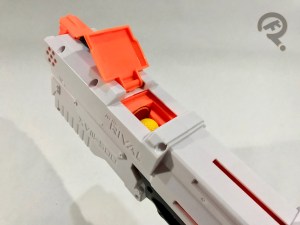
 The Kronos XVIII-500 was released in 2018 as part of the Phantom Corps subset of Rival blasters. I was initially under the impression that Phantom Corps was a Target exclusive line, but this blaster was purchased from TRU which confounded me to no end, at least for a few minutes. No idea what the deal with that is but whatever, you’re here to read about the blaster. The Kronos is a spring powered pistol with a 5 round integrated magazine à la MEGA Magnus or Star Wars Rey (Jakku) Blaster. Like both of those examples, the Kronos is loaded through a port on the top of the blaster that opens when the slide is primed back. The Kronos also has an additional flap covering the port which I guess isn’t really necessary but it does preserve the silhouette of the blaster a little bit. The shell of the blaster is all new and sports functional front and rear sights as well as 2 Rival accessory rails, one on the slide and one just above the muzzle. Interestingly, while the blaster is labeled “XVIII-500” on both sides, the name Kronos appears nowhere except on the packaging. Something to note about the rails on the Kronos is that, after attaching the Rival red dot sight, I noticed that it could slide back and forth just a little bit, just a few millimeters at most, and the nature of the attachment mechanism means it wasn’t in danger of falling off, but it’s just something I’d never had
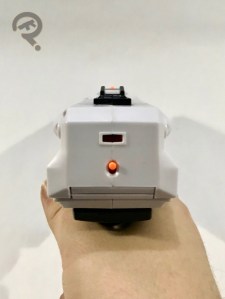
  any of my other Rival blaster do. I doubt that’s going to make or break anyone’s opinion of it, though. Aside from that, everything about the Kronos’ construction is solid. The grip in particular is very comfortable and secure in the hand as it follows much more organic lines than the more hard-lined rest of the blaster body, which is a style I quite like, visually and practically. The slide has a surprising amount of thought and engineering put into it. Priming the blaster is fairly easy with the grip panels that add a good amount of traction as well as providing a more defined surface to pull back on. On the underside of the slide, there are a couple of telescoping flat panels that extend when the slide is pulled back, I assume to either keep the mechanism clean or to prevent kids pinching their fingers in the internals. The very rear of the slide also has a cutout so you can see the orange plunger when it’s primed as well as a button to release the lockup if the blaster jams. Like all other Rival blasters, the Kronos has a safety which locks the trigger when engaged. Unfortunately this particular safety has the same after-the-fact addition kind of feeling that the Zeus’ had. It’s hard to describe verbally, but it feels like it’s flexing before it clicks rather than pivoting and is generally unpleasant to operate, not that it’s a necessary feature per se. For its size, the Kronos holds its own surprisingly well against other Rival blasters in terms of performance. Shots fly and hit with the expected Rival accuracy and power, making it a
  real terror for younger siblings, especially given how low profile and nimble it is due to its smaller size. I’ve even found that it fits rather handily into standard jeans pockets for holstering, just so long as you have jeans with actual pockets (why are fake pockets even a thing? Sorry, side-tracked). The Kronos comes packaged with another set of red and blue Rival flag/ribbon things, provided you got the Phantom Corps version and didn’t shell out $70 for the Deadpool variants, as well as one Rival round- what’s that? It comes with 5 rounds? Ok.. if you say so. Scratch that, I guess it’s supposed to come with 5 rounds. Hmm…
 Sometimes a really good idea isn’t something entirely brand new, but rather, a refinement of something that already exists. Up till this point, we’ve had the Raider CS-35, the Alpha Trooper CS-18, the Rampage, Elite Alpha Trooper, and Stormtrooper Deluxe blaster (the first one) that all fill the role of pump-action magazine fed blasters. Well, with Nerf’s latest wave of products, we have yet another to check off those boxes and then some. Let’s have a look at the Modulus Mediator.
 First things first, I have no idea why they went with “Mediator” for the name of a blaster. It doesn’t have quite the same sort of imposing punchy quality as something like the Rampage or Retaliator. Even in the context of a conflict, a mediator is supposed to be a neutral third party that gets two opposing sides to agree on something. I don’t know, just feels like a weird choice, but that’s what it’s called so I guess let’s just roll with it. The Mediator was released in 2018 as part of the Modulus line of products, Like I said, the Mediator operates much like other pump mag blasters but with 2 major differences. I would say they’re improvements, but I’m sure there are people who aren’t fans. Probably the same weirdos that thought The Last Jedi was the worst thing ever, but that’s neither here nor there. The shell of the Mediator is all new work apart from the standard Nerf barrel and stock attachment points. That actually brings us to the first big improvement, that being customizability. While you could expect to find a stock attachment and a rail on pretty much all other pump mag blasters, what you never found was a second rail (I’m counting the Raider/Rampage’s rails as one big one, fight me) or a barrel attachment lug, both of which the Mediator provides quite handily. The extra rail on the right
 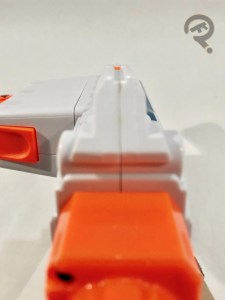 side obviously grants you greater potential for decking out your blaster with tactics. That’s all well and good, but the inclusion of the barrel lug is really what’s new. Given blasters like the Rampage and Alpha Trooper needed already pretty lengthy front ends to accommodate the pump action, extending the barrel further doesn’t make much sense as it would only work to slow the dart after being fired. As such, they never had barrel extension lugs, but the Mediator pulls it off thanks to it’s second major improvement over previous blasters. The whole thing is super compact with just a short little barrel. This means adding extra barrels doesn’t drastically reduce performance, which in turn means even more customization. The ergonomics of the Mediator are pretty great. I’d say it’s probably the best we’ve seen from the Modulus line so far. The pistol grip is a good size and has a really nice grippy texture to it that I haven’t seen before but certainly hope to see again. The same texture is also on the pump grip, which is a little short, but not enough to hinder, and I can understand the desire to not have it protrude too far from the body of the blaster. Everything feels nice and solid, though I wish the ratcheting on the pump grip was a little quieter when cycling the bolt. Nothing a little light modification can’t fix, though. My last gripe is purely aesthetic. I wish the blaster had a raised front sight parallel to the very prominent rear one. While this would have looked better in my opinion, it turns out the little stubby nub at the front end IS a front sight and is even relatively well calibrated to give slightly arced shots for a subtle boost to the range. On that note, the performance of the Mediator is decent. Shots fly and impact right on par with those of other comparable blasters. The ability to slam-fire is also a plus when busting into your younger sibling’s room and laying down heavy fire. The Mediator comes packaged with the magazine well detached (needs to be installed to operate the blaster), a 6 round magazine, and 6 white Modulus styled Elite darts.
 Alright, I know it would have been thematically more appropriate to do this review last week what with the whole Christmas thing that happened, but this is my (subsection on someone else’s) review site and I will do what I like. Besides, Ethan is still working through his annual haul, so it’s fine. Now that that’s out of the way, let’s have a look at the first Nerf blaster I’ve received for Christmas in, like, 8ish years. That would be the Rival Helios XVIII-700.
 The Helios was officially slated for release in 2018 but as you may have figured out, they slipped into circulation just a little early. So far it is only available in the Target exclusive Phantom Corps subset which means white is your only color option for the blaster itself. At first glance, it looks like just a revised design of Apollo and I suppose that’s not far off, functionally, but it’s certainly not just a reskin. Only the Jolt can get away with that. Like the Apollo, it is a spring powered blaster that uses standard Rival tube magazines loaded through the pistol grip. What’s different about the Helios is the addition of proper fore-grip and stock pieces, a jam door, and a new style of priming handle. Instead of being a vertical pull and push bolt handle like on the Apollo, the Helios has a side-mounted bolt handle with a spring return, so you just pull it back and let it snap forward again on its own. The whole motion is very satisfying and makes the Helios feel like an SMG or machine pistol. The fun doesn’t stop there, though, because those crafty folks at Hasbro worked out how to make the bolt handle removable and reversible, making the blaster
 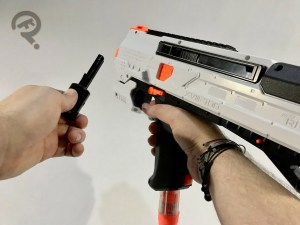 completely ambidextrous for all you sinister people out there. Either that or if you’re one of those Ghost Recon/Sam Fisher Ubisoft properties who might need to switch hands at a moments notice. Besides the obvious benefit of just a better priming action, the orientation of the bolt handle means there’s an actually usable line of sight as well as a bunch more rail space for attachments. As with all Rival blasters, it should be noted that it’s not an N-Strike style rail, so only Rival accessories will work. They’ve also changed the style of safety from a push button on the Apollo to a switch on both sides of the blaster, sticking with the ambidextrous theme. All put together, you have a very compact, solid blaster that is just a joy to operate and feels good in hand. The blaster runs very smooth, like how you would expect an improved Apollo to run. The power of the blaster is right on par with other Rival blasters, flying straight and hitting hard, definitely not something to use lightly when busting into your younger sibling’s room. Maybe save it for when they’ve actually earned it. The Helios comes packaged with a 7 round magazine, 7 Rival rounds, and, specific to the Phantom Corps line, two colored team flags, one red, one blue. I believe the purpose is for them to be attached to your person or your blaster to denote your team when playing competitively, but I just like putting them on my bag so everyone knows I’m a huge nerd who plays with Nerf blasters.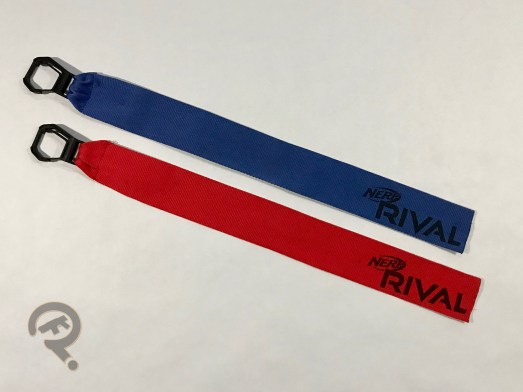


 One little word sure can make a big difference, especially when that word is “deluxe.” Yes, this is in fact a different blaster review from last week, it’s not a typo. So what does the First Order have to offer when “deluxe” is off the table? Well… not very much, as it happens, but let’s have a look at it anyway.
 The First Order Stormtrooper Blaster was released in 2015, alongside the deluxe version as a promotion for The Force Awakens. If you’re not sure what part of the movie it’s from, you can be forgiven for missing it because it doesn’t get a lot of screen-time, but it’s there, I promise. Now, having just recently The Last Jedi, I can tell you it gets a couple scenes where characters using it are front and center on the screen, so that’s nice. The blaster itself is almost as basic as you can get. It is a single shot, muzzle loaded pistol with a little spring loaded priming tab in the back. While the tab does a good job of maintaining the blaster’s aesthetics even when primed, it does mean the actual size of the plunger tube is severely limited. You can really get a sense of this by how short and light the priming stroke is. The outer shell is completely new to resemble the blaster from the film and looks pretty accurate… until you actually hold it. In the film, the SE-44C blaster, which this is designed after, is built on a Glock 17 pistol. If you’ve been keeping up with my Star Wars Nerf reviews, you’ll know that in general the Nerf blasters have pretty good ergonomics as they’re modeled after props that used real world firearms. In the case of the FOSB, the shape is right, but the scale is waaaaayyy off. It feels tiny in the hand. As such, the normally quite comfortable grip of the Glock has been shrunk down so it no longer lines up with regular human sized hands. I understand the reasoning behind it, because otherwise there would be just an unnecessarily large body housing a small internal mechanism. Sure, they could have scaled up the plunger tube to get more air into the system but that… actually, that’s a good idea. Why didn’t they just do that? I guess it’s probably safe to assume that it all comes down to cost cutting measures, as is so often the case. But hey, at least it comes with a cool attachment piece, right? I mean, it does come with an attachment piece which clips onto the standard Nerf rail on the top of the blaster, but what even is the piece supposed to be? As far as I can tell it’s a sight(ish) but it sits in the dead center of the blaster and has no other sight to line up to, so it’s kinda useless. It’s actually really useless, but its on the blaster in the film, so there it is. The FOSB’s performance is about what you’d expect for a Stormtrooper’s backup blaster. Distance and power are lacking pretty heavily from that of a regular N-Strike Elite blaster, but you can usually hit your target if the muzzle is just about 5 or 6 inches away from it, so… yay? Stormtroopers are meant to be imposing and scary, but a couple shot from this blaster and I doubt you’ll be able to maintain that kind of fear-based dominance over your younger siblings when you bust into their room. The First Order Stormtrooper Blaster comes packaged with the useless sight/spike thingy and 3 of the red Star Wars branded Elite darts.
 The Figure In Question